
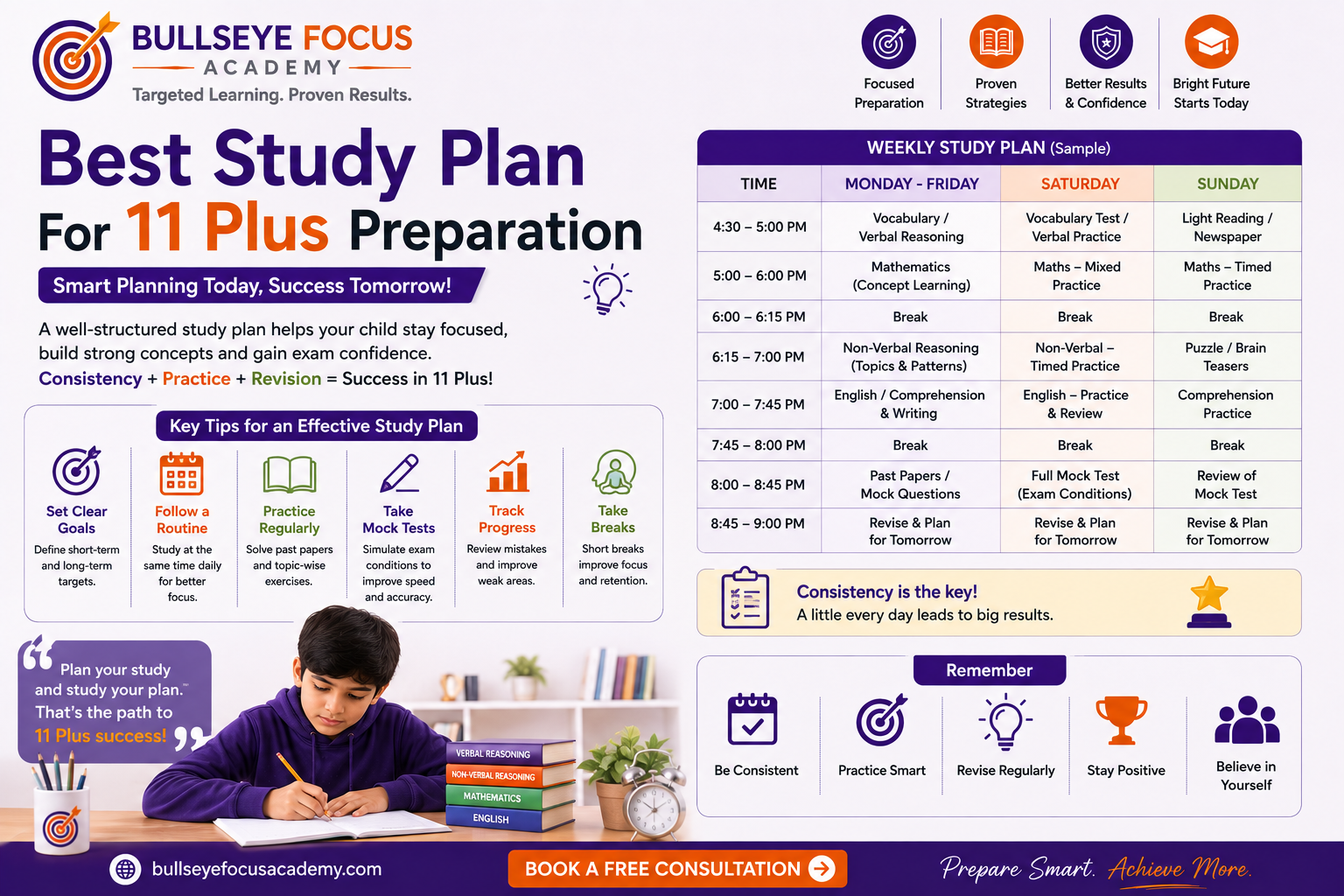
Best Study Plan for 11 Plus Preparation
Preparing for the 11 Plus can feel much easier when children have a clear and realistic routine. Instead of studying for long hours without a plan, a well-organized 11 Plus study schedule allows you to practice well-organized, consistent study; review difficult topics; and build confidence over time. Every child learns differently, so there is no single timetable that works for every family. Some children may need more time for math, while others may benefit from additional English, verbal reasoning, or non-verbal reasoning practice. The best approach is to create a flexible weekly routine that fits your child’s ability, schoolwork, interests, and available time.
A good study plan should also include breaks, reading, revision, mock exams, and free time. The aim is not to make every day feel like an exam. Instead, the routine should help children develop strong habits while keeping preparation positive and manageable. A well-planned 11 Plus Study Schedule gives parents a practical framework for organizing weekly preparation without making learning feel overwhelming.
Why Is an 11 Plus Study Schedule Important?
An organized 11 Plus Study Schedule gives children a clear idea of what they need to do and when they need to do it. This can reduce last-minute revision and help families keep preparation consistent.
Creates Consistency
Regular practice is generally more effective than occasional intensive study. A well-planned 11 Plus Study Schedule can help a child complete short, focused activities several times each week, providing more opportunities to reinforce skills and identify areas that need attention.
Helps Children Stay Organised
An 11 Plus Study Schedule can divide preparation into manageable activities. Instead of asking a child to study everything at once, parents can assign different subjects and skills to different days.
Reduces Last-Minute Pressure
Leaving preparation until the final weeks can make children feel overwhelmed. Starting with a sensible 11 Plus Study Schedule allows children to develop skills gradually and gives them time to revisit difficult topics.
Makes Progress Easier to Track
A study plan can also help parents see what their child has completed.
You can track:
- Subjects practiced
- Topics completed
- Mock exam scores
- Common mistakes
- Reading progress
- Areas requiring extra support
What Subjects Should an 11 Plus Study Plan Include?
The exact subjects depend on the grammar school and examination provider. Parents should check the requirements for their child’s target schools before creating a timetable. Parents can also check the official GL Assessment website for information about assessment products and resources used in education.
English
English preparation may include reading comprehension, vocabulary, spelling, grammar, punctuation, and understanding different types of passages. Children should practice reading carefully and answering questions based on the information provided.
Mathematics
Math preparation can cover arithmetic, problem-solving, fractions, decimals, percentages, geometry, measurement, and other age-appropriate topics. Regular practice can help children improve both accuracy and speed.
Verbal Reasoning
Verbal reasoning activities can involve words, vocabulary, relationships, sequences, codes, and language-based problems. Children often benefit from learning unfamiliar vocabulary alongside completing reasoning exercises.
Non-Verbal Reasoning
Non-verbal reasoning involves visual patterns, shapes, sequences, and relationships. Children should have opportunities to practice recognizing patterns and solving unfamiliar visual problems.
Reading
Reading should be included throughout the week rather than treated as a separate subject only before tests. Regular reading can improve vocabulary, comprehension, concentration, and familiarity with different writing styles.
How Many Hours Should a Child Study for the 11 Plus?
There is no universal number of hours that every child should study. The right amount of time in an 11 Plus Study Schedule depends on age, ability, school workload, preparation stage, and individual needs.
Focus on Quality
A focused 30-minute session can be more productive than a long session where the child is tired or distracted. Parents should aim for effective learning rather than simply counting study hours.
Consider Your Child’s Age
Younger children may benefit from shorter activities and more frequent breaks. As the exam approaches, children can gradually become comfortable with longer practice sessions and timed activities.
Avoid Overloading the Week
Children still need time for schoolwork, hobbies, exercise, friends, family, and relaxation. A balanced routine is more sustainable than an intense timetable that becomes difficult to maintain.
Example Weekly 11 Plus Study Schedule
The following is a general example of an 11 Plus Study Schedule that parents can adapt according to their child’s needs.
Monday: Mathematics and Reading
Start the week with a focused math session. Choose one topic that needs practice and complete a manageable set of questions. After math, encourage 20–30 minutes of enjoyable reading.
Tuesday: English and Vocabulary
Tuesday can focus on English comprehension, grammar, spelling, and vocabulary. Ask your child to learn a small number of new words and use them in sentences.
Wednesday: Verbal Reasoning and Review
Use Wednesday for verbal reasoning practice. After completing the questions, review mistakes rather than immediately moving on to another exercise. This can help identify recurring difficulties.
Thursday: Mathematics and Non-Verbal Reasoning
Return to math with a different topic or problem-solving activity. A short non-verbal reasoning session can follow. Keeping sessions varied can prevent preparation from becoming repetitive.
Friday: Light Practice and Reading
Friday can be a lighter preparation day. Complete a short exercise and spend additional time reading. This gives children a chance to reinforce learning without finishing the school week with a heavy study workload.
Saturday: Mock Exam or Longer Practice
Depending on the child’s preparation stage, Saturday can be used for a mock exam or a longer practice session. Do not necessarily complete a full mock exam every week. Shorter timed sections can also be useful.
Sunday: Rest and Review
Sunday can be used primarily for rest. If appropriate, spend a few minutes reviewing the week’s progress and planning the next week. Children should also have plenty of time for family activities and relaxation.
How to Build an 11 Plus Study Schedule Around Your Child
A timetable should be personalized rather than copied exactly from another family. When creating an 11 Plus Study Schedule, parents should consider the child’s current ability, school workload, preferred learning style, and areas that require additional practice.
Identify Strengths and Weaknesses
Start by identifying the subjects your child feels comfortable with and the areas that require more attention. For example, if maths is strong but vocabulary is weaker, an 11 Plus Study Schedule can include additional vocabulary practice without completely removing maths.
Set Weekly Goals
Choose a few achievable targets each week.
Examples include:
- Complete two maths topics
- Learn 15 new vocabulary words
- Finish two comprehension exercises
- Complete three reasoning sessions
- Read for 20 minutes on five days
Small targets can make preparation easier to manage.
Adjust the Routine Regularly
Your child’s needs may change as preparation progresses. A topic that once required three sessions may eventually need only one revision session. Use practice results to adjust the timetable rather than following the same schedule indefinitely.
How to Balance Schoolwork and 11 Plus Preparation
Children already have school responsibilities, homework, activities, and social commitments. An effective 11 Plus Study Schedule should work alongside these responsibilities rather than competing with them.
Prioritise School Responsibilities
Schoolwork should remain part of the overall learning routine. If a child has an important school assignment or assessment, the 11 Plus timetable may need to become lighter temporarily.
Use Short Study Sessions
Short sessions can fit more easily around school and other activities. For example, a child may complete a 20-minute vocabulary activity after school rather than trying to study for several hours.
Protect Family Time
Children need opportunities to relax and enjoy time away from academic work. Family time, hobbies, sports, and play can help prevent preparation from becoming overwhelming.
Include Reading in the Weekly Routine
Reading is one of the easiest activities to include in an 11 Plus preparation plan. Reading can easily become a regular part of an 11 Plus Study Schedule, especially when children enjoy choosing their own books.
Encourage Different Types of Reading
Children can read fiction, non-fiction, biographies, magazines, articles, and other age-appropriate material. Exposure to different writing styles can broaden vocabulary and comprehension skills.
Discuss the Reading
Parents can include reading discussions in an 11 Plus Study Schedule by asking simple questions about what their child has read.
For example:
- What was the main idea?
- Why did the character behave that way?
- What do you think will happen next?
- What does this word mean?
- Can you explain the passage in your own words?
These conversations can encourage deeper understanding.
Add Vocabulary Practice to the Schedule
Vocabulary can be developed gradually through a consistent 11 Plus Study Schedule.
Learn a Few Words Regularly
Instead of trying to learn a large list at once, introduce a small number of words each week. Children can write definitions, create sentences, and identify synonyms and antonyms.
Review Older Words
New vocabulary should not replace previously learned words. Include regular revision so that children have opportunities to remember and use vocabulary over time.
Include Timed Practice Gradually
Time management is an important part of exam preparation. However, children do not need to complete every activity under strict time limits from the beginning.
Begin Without Pressure
Start by helping children understand the question types. Make sure they understand how to approach the questions before focusing heavily on speed.
Introduce Short-Timed Activities
Once children are comfortable, introduce short, timed exercises. For example, they might complete a small group of questions within a set amount of time.
Progress Towards Exam Conditions
As the exam approaches, children can gradually complete longer timed sections and realistic mock exams. This approach can make exam conditions feel more familiar.
Use Mock Exams as Part of the Plan
Mock exams can provide useful information about preparation. They allow children to practice working through questions under realistic conditions and help parents identify areas for improvement.
Do Not Treat Every Mock Score as a Final Result
A mock exam is a learning tool. A lower score can show that a child needs more practice in a particular area. It does not automatically predict the final result.
Review Every Mock Exam
After a mock exam, look at:
- Incorrect answers
- Questions left unanswered
- Time management
- Careless mistakes
- Difficult topics
- Areas of improvement
Use this information to decide what should be included in next week’s 11 Plus study schedule. Parents looking for structured practice can explore the Bullseye Focus Academy Shop for available learning and preparation options.
How to Track Your Child’s Progress
Tracking progress can help parents make better decisions about their child’s 11 Plus Study Schedule and weekly routine.
Use a Simple Progress Table
A basic table could include:
| Week | Maths | English | Verbal Reasoning | Non-Verbal Reasoning | Mock Score |
|---|---|---|---|---|---|
| Week 1 | Practising | Good | Needs work | Good | 62% |
| Week 2 | Improving | Good | Improving | Needs work | 67% |
| Week 3 | Good | Improving | Good | Improving | 72% |
The purpose of tracking is to identify progress and weaknesses, not to pressure children.
Look for Patterns
One poor result does not necessarily indicate a problem. Instead, look for patterns over several weeks. If your child repeatedly struggles with the same type of question, that topic may need additional practice.
What Should Parents Do When a Child Falls Behind?
Sometimes children will not complete everything planned in their 11 Plus Study Schedule for the week. This is normal.
Do Not Panic
Missing one study session does not mean preparation has failed. Avoid trying to fit every missed activity into the next day.
Adjust the Following Week
Move important unfinished topics into the next week’s timetable and remove less important activities if necessary. The aim is to maintain a sustainable routine.
Keep Communication Open
Ask your child which activities they find difficult or tiring. Their feedback can help you create a more practical routine.
How Can Parents Keep 11 Plus Preparation Enjoyable?
Preparation should not feel like a punishment. A balanced 11 Plus Study Schedule can include variety and positive learning experiences, helping children stay engaged and motivated.
Mix Different Activities
Avoid completing the same type of worksheet every day.
Combine:
- Books
- Puzzles
- Reading
- Flashcards
- Timed exercises
- Mock exams
- Educational games
- Vocabulary activities
Celebrate Improvement
Praise effort and progress rather than focusing only on marks. For example, if a child improves their accuracy or completes a difficult topic independently, recognise that achievement.
Include Breaks
Breaks are essential. Children should have enough time to rest between activities and enjoy non-academic interests.
Common Mistakes Parents Should Avoid
Even a well-planned routine can become stressful if it is not implemented carefully.
Studying for Too Many Hours
More study does not automatically mean better results. Long sessions can cause tiredness and reduce concentration.
Changing the Routine Every Day
A timetable should have enough consistency for children to develop habits. Make changes when necessary, but avoid constantly changing the plan without a clear reason.
Focusing Only on Weak Subjects
Weak areas need attention, but children should also continue practicing subjects they enjoy and perform well in. Balanced preparation can help maintain motivation.
Ignoring the Child’s Feedback
Parents should listen to how their child feels about the routine. If a timetable is consistently causing stress, it may need to be adjusted.
When Should You Change the Study Schedule?
An 11 Plus Study Schedule should not remain exactly the same throughout the entire preparation period.
When a Topic Improves
Reduce practice time for topics that become secure and redirect some time towards areas that need attention.
Before the Exam
As the exam gets closer, include more realistic timed practice and mock exams. However, avoid suddenly increasing the workload dramatically.
When Your Child Becomes Overwhelmed
If your child appears consistently tired, frustrated, or anxious, review the timetable. Reducing unnecessary pressure may improve the quality of learning.
A Simple Daily Study Routine
Families that prefer a daily structure can use a simple pattern.
After School
Allow your child to relax and have a snack before starting academic work.
First Activity
Complete one focused subject session, such as math or English.
Break
Take a short break before beginning another activity.
Second Activity
Complete a shorter reasoning, vocabulary, or reading task.
Evening
Keep the evening relaxed. Reading for pleasure can be included without making it feel like another formal lesson.
This 11 Plus Study Schedule structure can be adjusted depending on the child’s age and schedule.
Frequently Asked Questions About an 11 Plus Study Schedule
How many days a week should my child study for the 11 Plus?
There is no universal number of days that works for every child. A consistent 11 Plus Study Schedule spread throughout the week can be more effective than occasional intensive study. Parents should consider schoolwork, age, ability, exam timing, and other commitments when creating a suitable weekly plan.
How long should an 11 Plus study session be?
Study sessions in an 11 Plus Study Schedule should be long enough to achieve a specific learning goal without causing unnecessary tiredness. Younger children may benefit from shorter activities, while older children can gradually handle longer sessions. The focus should remain on concentration, understanding, and quality rather than simply studying for a fixed number of hours.
Should my child study every day for the 11 Plus?
Not necessarily. Children need rest, hobbies, family time, and opportunities to relax. A few focused sessions throughout the week may be more sustainable than studying intensively every day. An 11 Plus Study Schedule can include relaxed daily reading, while more structured academic practice can be scheduled on selected days.
When should I start using an 11 Plus study schedule?
The ideal starting point for an 11 Plus Study Schedule depends on your child’s target exam, current ability, and school requirements. Starting with a manageable routine gives children time to develop skills gradually. Parents should avoid creating an unnecessarily intense timetable too early and should adapt the routine as the exam approaches.
Should weekends be included in an 11 Plus study schedule?
Weekends can be useful for longer practice sessions or mock exams because children may have more free time. However, an 11 Plus Study Schedule should not become entirely focused on study. Include rest, hobbies, family activities, and free time so that preparation remains balanced and manageable.
How often should my child take an 11 Plus mock exam?
Mock exam frequency depends on the child’s preparation stage. Early in preparation, shorter practice sections may be more appropriate. As the exam approaches, realistic mock exams can become more useful. An 11 Plus Study Schedule can include mock exams at suitable intervals, helping children prepare effectively without becoming overwhelmed. Always review results afterwards so that each mock contributes to future learning and preparation.
What if my child refuses to follow the study schedule?
Talk to your child about what they find difficult. The 11 Plus Study Schedule may be too demanding, repetitive, or poorly timed. Consider reducing session length, adding variety, or giving your child limited choices. A flexible routine that your child can follow consistently is generally more useful than a perfect timetable they dislike.
Should the 11 Plus study schedule include school homework?
Yes. School responsibilities should be considered when planning the week. Avoid creating an 11 Plus Study Schedule that leaves children exhausted after completing their normal schoolwork. On particularly busy school days, a short preparation activity or reading session may be enough.
How can I know whether the study schedule is working?
Look for gradual improvements in understanding, accuracy, speed, confidence, and independence. An 11 Plus Study Schedule can help track these areas over time. Mock exam results can provide additional information, but they should not be the only measure. If your child continues struggling with particular topics, adjust the timetable to provide more targeted practice.
Can I change the study schedule when needed?
Yes. A good 11 Plus Study Schedule should be flexible. Children’s needs change as they learn new topics and become stronger in certain areas. Review the routine regularly and make adjustments based on school commitments, practice results, exam dates, and your child’s well-being.
Final Thoughts on Creating an 11 Plus Study Schedule
The best 11 Plus Study Schedule is not necessarily the most demanding one. It is the routine that your child can follow consistently without feeling overwhelmed. A successful weekly plan should balance maths, English, verbal reasoning, non-verbal reasoning, reading, revision, timed practice, and mock exams. It should also leave enough space for sleep, hobbies, family time, exercise, and relaxation. Parents should use the schedule as a guide rather than a strict set of rules. If a child needs more time on a difficult topic, make the necessary adjustment. If school becomes particularly busy, reduce the workload temporarily.
The goal is steady progress. With a friendly, flexible, and consistent approach, children can develop stronger academic skills, better time management, and greater confidence before the 11 Plus. For additional preparation options, visit the Bullseye Focus Academy Shop. If you would like to discuss preparation and support options, you can also contact Bullseye Focus Academy.