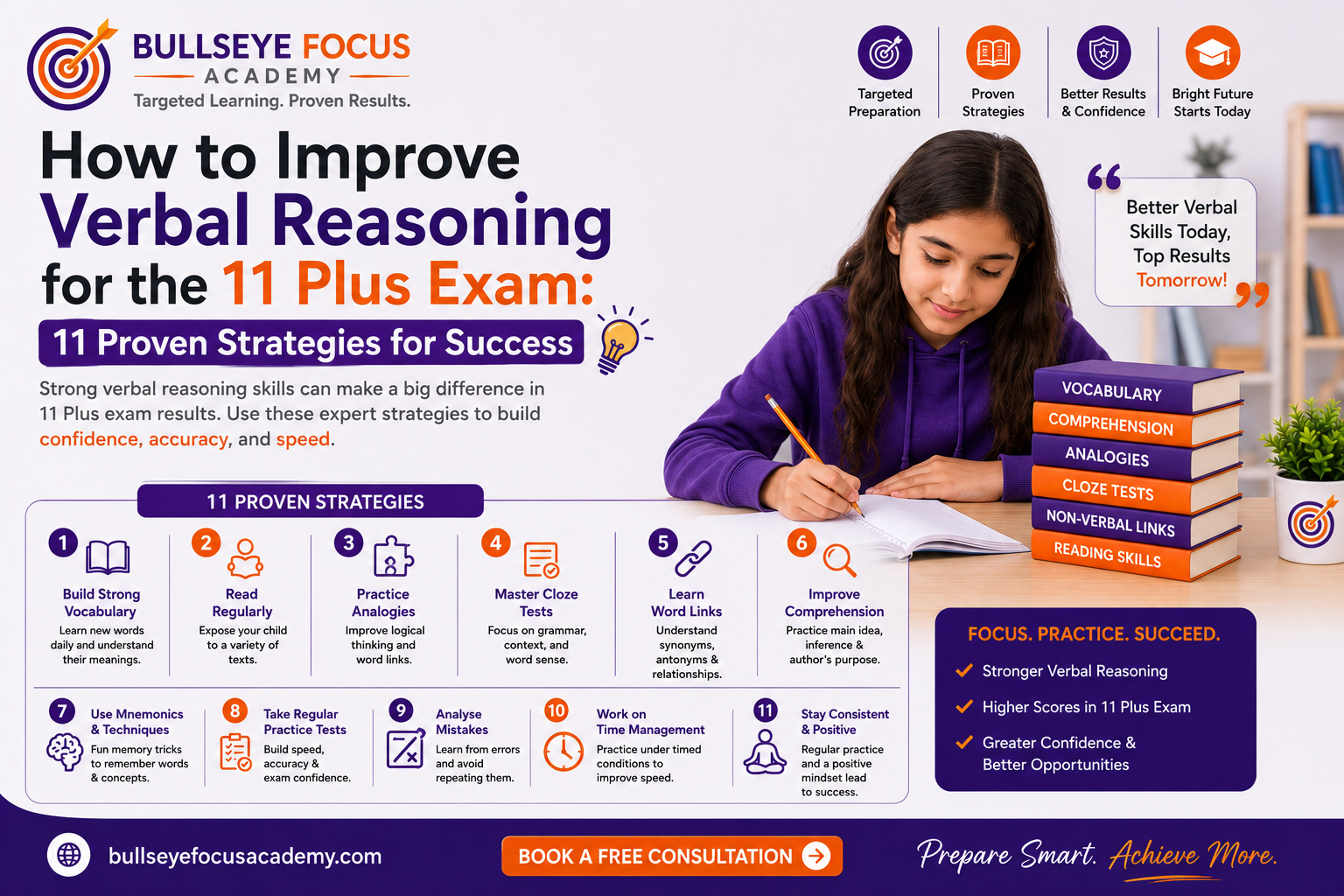
How to Improve Verbal Reasoning for the 11 Plus Exam: 11 Proven Strategies for Success
Preparing for the 11 Plus examination requires students to develop a wide range of academic skills, but one area that often challenges children is 11 Plus Verbal Reasoning. Many parents notice that while their child performs well in English and Mathematics, verbal reasoning questions can seem unfamiliar and difficult. The good news is that verbal reasoning is a skill that can be improved with the right preparation, consistent practice, and effective learning strategies.
11 Plus Verbal Reasoning assesses a child’s ability to understand language, recognise relationships between words, identify patterns, solve logical problems, and apply reasoning skills under timed conditions. Unlike subjects that rely mainly on classroom knowledge, verbal reasoning measures how well students think, analyse information, and solve problems using words and language. Many grammar schools and selective independent schools include verbal reasoning because it helps identify students with strong analytical thinking and problem-solving abilities. Success is not simply about having an extensive vocabulary. Students must also understand instructions, think logically, manage time effectively, and remain calm during the examination.
Parents often wonder whether verbal reasoning can really be improved. The answer is yes. With structured preparation, daily reading, vocabulary development, and regular practice, children can make significant progress over time. Small improvements made consistently often produce excellent results by the time the examination arrives.
Families looking for structured preparation and expert guidance can explore: https://bullseyefocusacademy.com/
Practice materials and learning resources are available at: https://bullseyefocusacademy.com/shop/
What Is 11 Plus Verbal Reasoning?
11 Plus Verbal Reasoning is designed to assess how well students use language to solve problems rather than simply recalling facts they have learned at school.
Questions often require children to:
- Understand word meanings
- Identify relationships between words
- Recognise patterns
- Complete sequences
- Solve logical puzzles
- Follow written instructions carefully
- Analyse information quickly
Every examination provider uses slightly different question styles, but the aim remains the same: to evaluate reasoning ability using language. Because verbal reasoning tests thinking skills rather than memorised knowledge, students benefit from regular practice with a variety of question types.
Why Is Verbal Reasoning Important?
Grammar schools look for students who can think critically, solve unfamiliar problems, and apply logical reasoning.
Strong 11 Plus Verbal Reasoning skills demonstrate that a child can:
- Interpret written information
- Understand complex instructions
- Recognise patterns
- Make logical decisions
- Learn new concepts efficiently
These abilities support academic success not only during the 11 Plus examination but also throughout secondary education. Verbal reasoning also strengthens everyday learning by improving reading comprehension, communication, and problem-solving skills.
Common Types of Verbal Reasoning Questions
Parents are often surprised by the variety of questions included in 11 Plus Verbal Reasoning papers.
Students may encounter:
- Synonyms
- Antonyms
- Letter sequences
- Word codes
- Missing words
- Analogies
- Letter combinations
- Hidden words
- Logical deductions
- Vocabulary questions
- Alphabet-based problems
The exact question types vary depending on the school and examination provider, making broad practice particularly valuable.
Why Many Students Find Verbal Reasoning Difficult
Unlike mathematics or English, verbal reasoning is rarely taught as a separate classroom subject. Many children therefore encounter unfamiliar question formats during preparation.
Common challenges include:
- Limited vocabulary
- Difficulty recognising patterns
- Reading too quickly
- Misunderstanding instructions
- Poor time management
- Lack of confidence
- Limited practice experience
Fortunately, each of these difficulties can be improved through structured learning and consistent practice.
Strategy 1: Read Every Day
Daily reading is one of the most effective ways to strengthen 11 Plus Verbal Reasoning.
Reading introduces children to:
- New vocabulary
- Different sentence structures
- Word meanings
- Grammar
- Context clues
Encourage children to read a wide variety of materials, including:
- Fiction
- Non-fiction
- Newspapers
- Educational magazines
- Children’s novels
- Biographies
Discuss unfamiliar words together and encourage children to use them in everyday conversation. Even twenty minutes of daily reading can make a noticeable difference over time.
Strategy 2: Build Vocabulary Systematically
Vocabulary forms the foundation of strong 11 Plus Verbal Reasoning performance. Children with broader vocabularies usually find reasoning questions easier because they understand more word relationships.
Parents can improve vocabulary by encouraging children to:
- Learn five new words each week.
- Keep a vocabulary notebook.
- Use new words in sentences.
- Review previous vocabulary regularly.
- Play word-based games.
Rather than memorising long lists of words, students should focus on understanding meanings and practical usage.
Strategy 3: Practise Different Question Types
Many students repeatedly practice only one style of verbal reasoning question. A more effective approach is to experience a wide variety of formats.
Students should regularly practice:
- Synonyms
- Antonyms
- Analogies
- Letter sequences
- Word relationships
- Code questions
- Classification exercises
- Logical reasoning tasks
Exposure to different question styles improves flexibility and reduces surprises during the examination.
Strategy 4: Learn to Identify Patterns
Pattern recognition is an essential skill in 11 Plus Verbal Reasoning.
Many questions require students to recognize relationships between:
- Letters
- Words
- Sounds
- Sequences
- Categories
Encourage children to slow down and look carefully for similarities before selecting an answer. Over time, recognizing patterns becomes faster and more natural.
Strategy 5: Improve Reading Accuracy
Many children lose marks because they misunderstand the question rather than because they lack knowledge.
Students should develop the habit of:
- Reading every question carefully.
- Underlining important words.
- Checking instructions twice.
- Avoiding rushed decisions.
- Eliminating incorrect answers.
Improved reading accuracy reduces careless mistakes and increases confidence.
Strategy 6: Develop Time Management Skills
Time pressure is one of the biggest challenges during 11 Plus Verbal Reasoning examinations. Students should practice completing questions within realistic time limits.
Useful techniques include:
- Starting with easier questions.
- Skipping difficult questions temporarily.
- Returning later if time remains.
- Monitoring progress throughout the paper.
Regular timed practice gradually improves both speed and accuracy.
Strategy 7: Learn From Mistakes
Every practice session provides an opportunity to improve.
After completing 11 Plus Verbal Reasoning exercises, students should review:
- Incorrect answers
- Questions guessed correctly
- Common errors
- Difficult vocabulary
- Time management issues
Keeping an error notebook helps identify recurring weaknesses. Students often discover that similar mistakes appear repeatedly until they are corrected through focused practice.
Creating a Weekly Verbal Reasoning Study Plan
A structured routine helps children improve steadily without feeling overwhelmed.
A simple weekly schedule may include:
Monday
- Vocabulary practice
- Reading for twenty minutes
Tuesday
- Synonyms and antonyms
- Word relationship exercises
Wednesday
- Letter sequence questions
- Pattern recognition activities
Thursday
- Timed verbal reasoning practice
- Review difficult questions
Friday
- Vocabulary revision
- Reading comprehension
Weekend
- Full 11 Plus Verbal Reasoning practice paper
- Detailed review of mistakes
This balanced routine encourages gradual improvement while preventing burnout.
Official Information About Entrance Assessments
Parents who would like to learn more about assessment providers and educational testing can visit the official GL Assessment website: https://www.gl-assessment.co.uk/
Reviewing official educational information helps parents understand assessment standards and examination expectations more clearly.
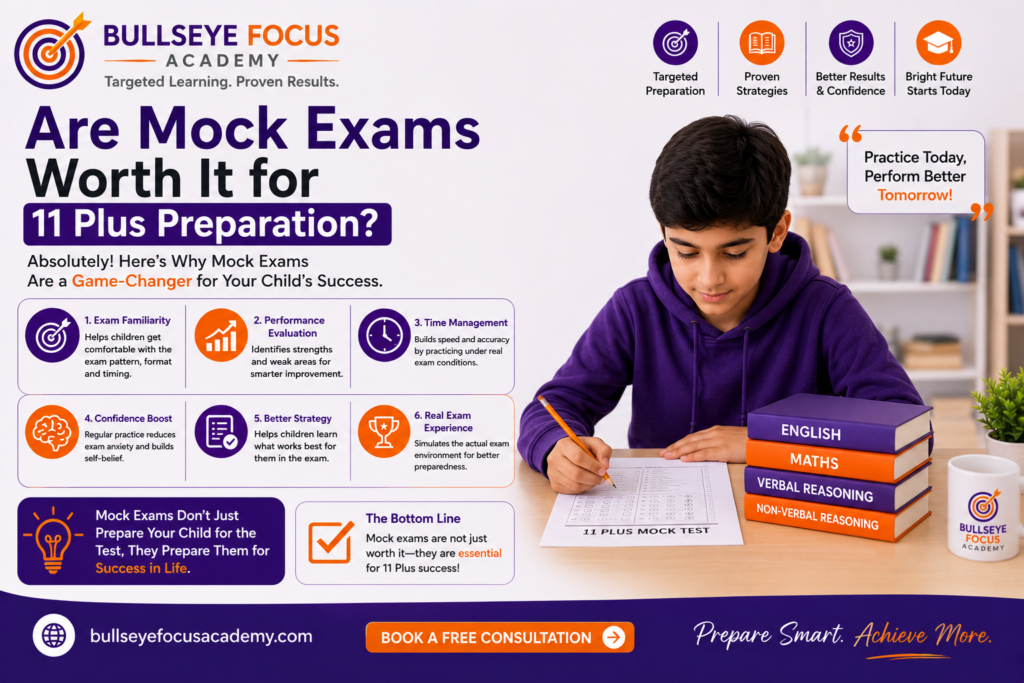
Strategy 8: Complete Regular Mock Exams
One of the most effective ways to improve 11 Plus Verbal Reasoning is by completing regular mock exams. Practice under realistic exam conditions helps students become familiar with question styles, time limits, and the pressure of working independently.
Mock exams help children:
- Improve time management.
- Build confidence.
- Reduce exam anxiety.
- Develop exam techniques.
- Identify weaker areas.
After each mock exam, students should carefully review every mistake instead of simply checking the final score. Understanding why an answer was incorrect is one of the fastest ways to improve future performance.
Strategy 9: Strengthen Logical Thinking Skills
Verbal reasoning is closely connected to logical thinking. Children who regularly solve puzzles and reasoning activities often become better at identifying patterns and analysing information.
Helpful activities include:
- Crossword puzzles
- Word games
- Logic puzzles
- Alphabet challenges
- Code-breaking activities
- Word association games
These enjoyable activities improve analytical thinking while keeping learning engaging.
Strategy 10: Stay Consistent With Practice
Many parents believe that long study sessions produce better results. In reality, consistency is much more effective than occasional intensive revision. Improving 11 Plus Verbal Reasoning requires regular practice over several months.
Students benefit from:
- Short daily practice sessions.
- Weekly revision.
- Regular vocabulary review.
- Frequent reading.
- Timed reasoning exercises.
Even thirty minutes of focused practice each day can produce significant improvement over time.
Strategy 11: Maintain a Positive Mindset
Confidence plays a major role in examination success. Children sometimes believe they are “bad at verbal reasoning” simply because they find certain question types difficult.
Parents should encourage children to:
- View mistakes as learning opportunities.
- Celebrate small improvements.
- Remain patient.
- Continue practicing consistently.
- Believe in their progress.
A positive attitude often leads to greater motivation and stronger long-term performance.
How Parents Can Support Verbal Reasoning Preparation
Parents have an important role in helping children develop strong 11 Plus Verbal Reasoning skills.
Simple ways to provide support include:
- Reading together regularly.
- Discussing new vocabulary.
- Encouraging questions.
- Creating a quiet study environment.
- Maintaining a regular study routine.
- Praising effort rather than perfection.
Children who receive positive encouragement usually develop greater confidence and enjoy learning more.
Common Mistakes Students Should Avoid
Some preparation habits can reduce progress even when students work hard.
Memorising Instead of Understanding
Verbal reasoning is about thinking logically rather than memorising answers. Students should understand why each answer is correct.
Ignoring Vocabulary Development
A strong vocabulary supports many different verbal reasoning question types. Daily reading and learning new words should remain part of every study plan.
Rushing Through Questions
Many students lose marks by answering too quickly. Reading instructions carefully often prevents unnecessary mistakes.
Skipping Difficult Questions During Revision
Students sometimes avoid practicing question types they find challenging. Instead, these questions should receive additional attention because they provide the greatest opportunity for improvement.
Practicing Without Reviewing Mistakes
Completing practice papers without analyzing errors limits improvement. Every incorrect answer should become a learning opportunity.
Signs That Verbal Reasoning Skills Are Improving
Parents often ask how they can measure progress.
Positive signs include the following:
- Faster completion of practice papers.
- Improved vocabulary.
- Greater confidence.
- Better accuracy.
- Fewer repeated mistakes.
- Stronger logical thinking.
- Improved reading comprehension.
These improvements often appear gradually, making consistent practice particularly important.
Creating a Balanced Study Routine
Strong 11 Plus Verbal Reasoning preparation should be balanced with other subjects.
A healthy study routine might include:
English
- Reading comprehension
- Vocabulary building
- Grammar practice
Mathematics
- Mental arithmetic
- Problem-solving
- Timed calculations
Verbal Reasoning
- Pattern recognition
- Word relationships
- Timed reasoning exercises
Non-Verbal Reasoning
- Shape recognition
- Visual patterns
- Logical puzzles
Revision
- Reviewing mistakes
- Practicing weaker topics
- Mock examinations
Balancing subjects prevents fatigue and supports overall academic development.
Why Personalised Learning Makes a Difference
Every child develops reasoning skills at a different pace. Some students quickly master vocabulary but need additional support with logical thinking. Others understand reasoning questions well but require more practice managing time. Personalized preparation allows students to focus on their individual needs rather than following a one-size-fits-all approach.
Parents looking for personalized guidance can contact: https://bullseyefocusacademy.com/contact-us/
Long-Term Benefits of Verbal Reasoning Skills
Strong 11 Plus Verbal Reasoning skills continue benefiting students long after the entrance examination.
These skills help improve:
- Reading comprehension.
- Critical thinking.
- Problem-solving.
- Communication.
- Analytical ability.
- Independent learning.
- Academic confidence.
Developing reasoning skills supports success across many school subjects and future educational challenges.
FAQs
What is 11 Plus Verbal Reasoning?
11 Plus Verbal Reasoning assesses a student’s ability to solve problems using language, recognize word relationships, identify patterns, understand vocabulary, and apply logical thinking. It measures reasoning ability rather than simple memorization and is commonly included in grammar school entrance examinations.
How can my child improve 11 Plus Verbal Reasoning?
Children can improve 11 Plus Verbal Reasoning through regular reading, vocabulary development, practicing different question types, completing timed exercises, reviewing mistakes, and taking mock examinations. Consistent daily practice usually produces the best long-term results.
Is vocabulary important for verbal reasoning?
Yes. A strong vocabulary makes 11 Plus Verbal Reasoning questions much easier because students understand word meanings, synonyms, antonyms, and relationships more quickly. Reading regularly is one of the best ways to expand vocabulary naturally.
How often should students practice verbal reasoning?
Most students benefit from practicing 11 Plus Verbal Reasoning for twenty to thirty minutes several times each week. Short, consistent sessions are generally more effective than occasional long study periods.
Do mock exams help improve verbal reasoning?
Yes. Mock examinations improve 11 Plus Verbal Reasoning by developing time management, reducing exam anxiety, strengthening concentration, and familiarising students with realistic examination conditions. Reviewing mistakes after every mock paper is essential for continuous improvement.
Conclusion
Strong 11 Plus Verbal Reasoning skills are developed through consistent practice, effective learning strategies, and a positive approach to preparation. While many students initially find verbal reasoning challenging because of unfamiliar question types, regular reading, vocabulary building, logical thinking exercises, and timed practice can significantly improve performance over time.
Parents play a valuable role by creating supportive learning environments, encouraging daily reading, celebrating progress, and helping children learn from mistakes rather than fearing them. Mock examinations, personalized study plans, and careful review of weaker areas also contribute to steady improvement and greater confidence.
Most importantly, success in 11 Plus Verbal Reasoning is not achieved overnight. It comes from small, consistent improvements made over many weeks of focused preparation. With patience, structured practice, and the right support, students can strengthen their reasoning abilities, approach the examination with confidence, and build valuable thinking skills that continue benefiting them throughout their education and beyond.