
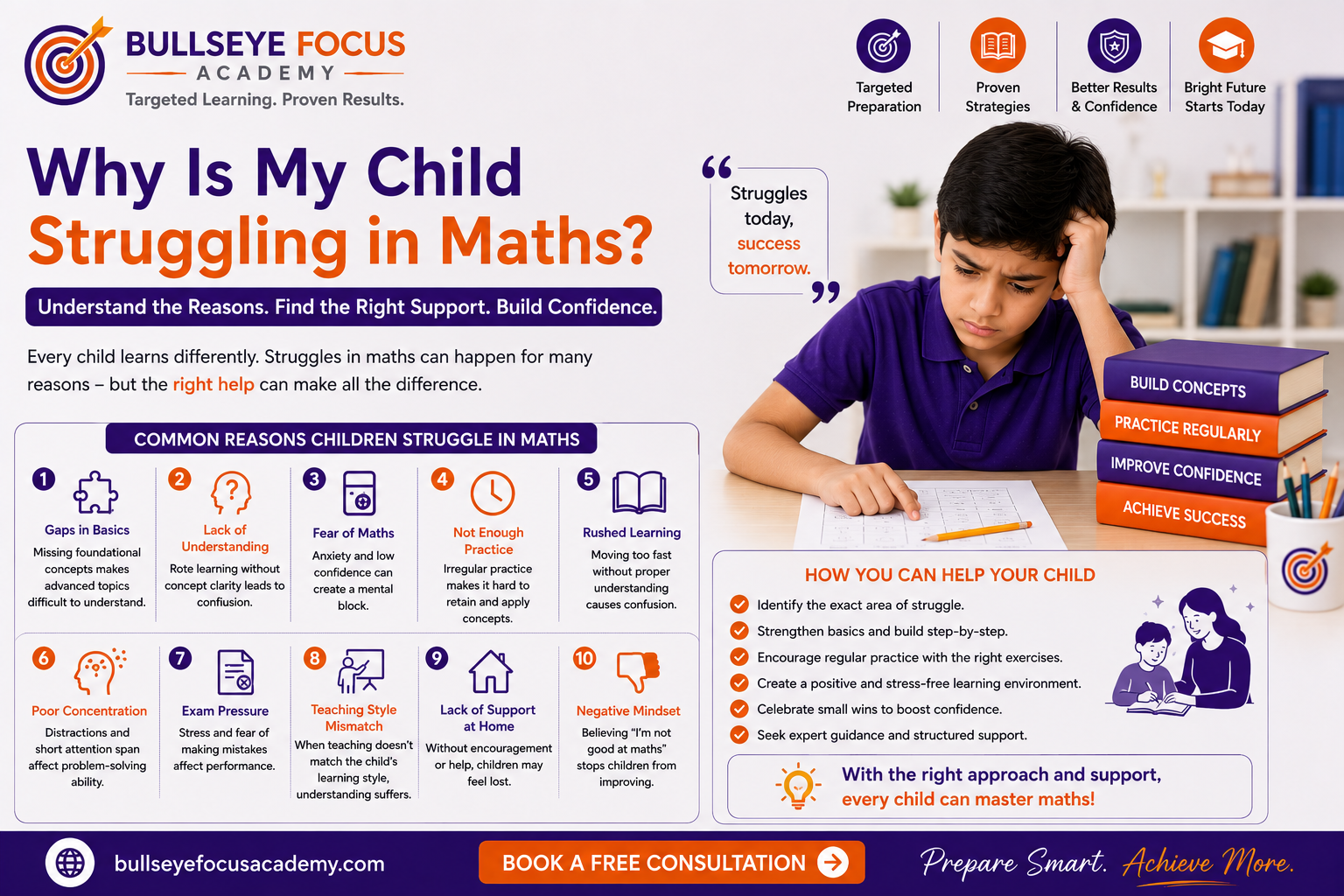
Why Is My Child Struggling in Maths?
Many parents become concerned when they notice their child finding maths difficult. They may see falling test scores, frustration during homework, or a lack of confidence when solving simple calculations. If you are wondering why your Child Struggling Maths at school or at home, you are not alone. Mathematics is one of the subjects that many children find challenging, but with the right support and approach, these difficulties can often be overcome.
Maths is a subject where each new topic builds upon previous knowledge. If a child misses or misunderstands a basic concept, future topics may become increasingly difficult. This can lead to frustration, reduced confidence, and a belief that they are simply “not good at maths.” In reality, most children can improve their mathematical skills through structured learning, regular practice, and positive encouragement.
Parents play a significant role in helping children develop confidence in mathematics. Creating a supportive environment, understanding the reasons behind learning difficulties, and providing consistent encouragement can make a noticeable difference. Rather than focusing only on marks, parents should aim to help children enjoy learning and celebrate steady progress.
Why Many Children Find Maths Difficult
Mathematics requires several different skills working together. Children must understand numbers, recognise patterns, solve problems, remember methods, and apply logical thinking. If one of these areas is weak, learning can become more challenging.
Some children struggle because they:
- Missed important foundational concepts.
- Learn at a different pace.
- Feel anxious about making mistakes.
- Need more practice.
- Have low confidence.
- Find abstract concepts difficult.
A Child Struggling Maths does not necessarily lack ability. In many cases, they simply need more time, different teaching methods, or additional practice.
Signs Your Child Is Struggling with Maths
Recognizing the early signs allows parents to provide support before difficulties become more serious.
Common signs include:
- Avoiding maths homework.
- Becoming frustrated during calculations.
- Taking much longer than expected to complete tasks.
- Frequently making simple calculation mistakes.
- Feeling anxious before maths lessons or tests.
- Saying “I’m not good at maths.”
- Losing confidence in school.
Some children may also become quiet during maths lessons because they are worried about giving incorrect answers. Early support can prevent small gaps in learning from becoming larger problems later.
Common Reasons Children Struggle with Maths
Every child learns differently, and there is rarely a single reason for mathematical difficulties. Understanding the underlying causes helps parents choose the most effective support.
Weak Number Foundations
Strong mathematical skills begin with a solid understanding of basic number concepts.
Children who struggle with:
- Addition.
- Subtraction.
- Multiplication.
- Division.
- Number bonds.
- Place value.
may also find more advanced topics challenging. A Child Struggling Maths often benefits from revisiting these core skills before moving on to more complex calculations.
Maths Anxiety
Maths anxiety is one of the most common barriers to learning. Some children become nervous whenever they see numbers or are asked to solve problems quickly.
This anxiety may develop because of:
- Fear of making mistakes.
- Previous poor results.
- Pressure to perform well.
- Comparing themselves with classmates.
- Negative experiences in the classroom.
When children feel anxious, they often find it more difficult to concentrate and remember what they have learned. Creating a calm and encouraging learning environment helps reduce this anxiety.
Lack of Regular Practice
Like reading or learning a musical instrument, mathematics improves with consistent practice. Children who only practise occasionally may struggle to remember important methods and calculations. Short daily practice sessions are usually more effective than studying for several hours once each week.
Parents can encourage regular practice through:
- Mental maths activities.
- Educational games.
- Short revision exercises.
- Real-life maths situations.
Consistent practice helps children build confidence gradually.
Difficulty Understanding Concepts
Some children can memorize methods without fully understanding why those methods work. For example, they may know how to complete a calculation but become confused when the question is presented differently. A Child Struggling Maths often needs visual explanations, practical examples, and step-by-step guidance rather than memorizing procedures. Helping children understand mathematical concepts leads to stronger long-term learning.
Low Confidence
Confidence has a major influence on academic performance. Children who believe they cannot succeed in maths often stop trying when questions become difficult.
Low confidence may develop after:
- Repeated mistakes.
- Difficult tests.
- Comparing themselves with others.
- Receiving negative feedback.
Parents should praise effort, improvement, and persistence rather than focusing only on correct answers. Positive encouragement helps children develop a growth mindset and become more willing to tackle challenging problems.
Poor Study Habits
Effective learning depends on good study routines.
Some children struggle because they:
- Rush through homework.
- Skip difficult questions.
- Do not review mistakes.
- Become distracted during study sessions.
Parents can help by creating a consistent study routine that includes regular practice, short breaks, and careful review of completed work.
Gaps in Previous Learning
Mathematics follows a logical sequence where each topic builds upon earlier knowledge. If a child has missed important lessons or misunderstood previous topics, future learning becomes more difficult.
For example, difficulties with fractions may later affect the following:
- Percentages.
- Decimals.
- Ratios.
- Algebra.
Identifying and addressing these learning gaps helps children regain confidence and make steady progress.
How Parents Can Help at Home
Parents do not need to be maths experts to make a positive difference. Simple daily support can significantly improve learning.
Helpful strategies include:
- Encouraging daily maths practice.
- Reading questions together.
- Using positive language.
- Celebrating progress.
- Being patient during homework.
- Asking children to explain their thinking.
These activities help parents understand where difficulties occur while encouraging children to develop stronger problem-solving skills.
Simple Daily Activities That Improve Maths Skills
Mathematics can be practiced naturally during everyday life.
Parents can involve children in activities such as the following:
- Shopping and calculating totals.
- Measuring ingredients while cooking.
- Reading timetables.
- Counting money.
- Estimating distances.
- Playing board games involving numbers.
These practical experiences help children understand that maths is useful beyond the classroom.
The Importance of Building Confidence
Many children improve once they begin believing they can succeed.
Parents can help build confidence by:
- Setting achievable goals.
- Recognizing small improvements.
- Encouraging questions.
- Avoiding criticism.
- Remaining positive.
A confident Child Struggling Maths is usually more willing to attempt difficult questions and continue learning after making mistakes, as improved confidence helps children develop resilience, problem-solving skills, and a more positive approach towards mathematics.
For personalized learning support, families can visit: https://bullseyefocusacademy.com/contact-us/
When Should Parents Seek Extra Support?
Every child learns at their own pace, but there are times when additional support may be beneficial. If a Child Struggling Maths continues to experience difficulties despite regular practice and encouragement, seeking extra guidance can help prevent learning gaps from becoming larger.
Parents should consider additional support if their child:
- Frequently struggles with basic calculations.
- Avoids maths lessons or homework.
- Shows little improvement over several months.
- Becomes extremely anxious about maths.
- Finds age-appropriate questions consistently difficult.
- Has difficulty applying mathematical concepts in different situations.
Early intervention often helps a Child Struggling Maths rebuild confidence before frustration affects other areas of learning, allowing children to strengthen their mathematical skills, develop positive study habits, and approach future challenges with greater confidence.
How Tutors and Extra Learning Can Help
Some children benefit from personalized support that focuses on their individual learning needs.
Additional learning can help students:
- Strengthen basic maths skills.
- Understand difficult concepts.
- Practice at an appropriate pace.
- Build confidence gradually.
- Receive individual feedback.
- Develop effective study habits.
A Child Struggling Maths may progress more quickly when lessons are adapted to match their learning style rather than following a one-size-fits-all approach.
Encourage a Growth Mindset
One of the most valuable lessons parents can teach is that ability develops through practice and perseverance. Children should understand that making mistakes is a normal part of learning.
Parents can encourage positive thinking by saying the following:
- “Let’s work through this together.”
- “Mistakes help us learn.”
- “You’re improving every week.”
- “Keep trying—you’ll understand it soon.”
A positive attitude encourages a Child Struggling Maths to continue learning even when questions become more challenging, helping them build confidence, develop problem-solving skills, and stay motivated throughout their maths learning journey.
Make Maths Part of Everyday Life
Children often enjoy mathematics more when they see how it applies to real situations.
Parents can involve maths in daily activities such as:
- Comparing prices while shopping.
- Measuring ingredients during cooking.
- Reading bus or train timetables.
- Calculating travel times.
- Counting change.
- Planning household budgets.
These activities help a Child Struggling Maths understand that mathematics is useful beyond school and develops practical problem-solving skills.
Common Mistakes Parents Should Avoid
Parents naturally want their children to succeed, but some approaches may unintentionally reduce confidence in a Child Struggling Maths. A supportive and patient approach helps children feel encouraged, develop resilience, and improve their mathematical skills over time.
Comparing Children
Every child develops mathematical understanding at a different pace. A Child Struggling Maths should never feel compared with siblings, classmates, or friends. Instead, celebrate personal progress and individual achievements.
Focusing Only on Marks
Test scores provide useful information, but they do not measure effort, determination, or growing confidence.
Parents should also recognise:
- Improved understanding.
- Better concentration.
- Increased independence.
- Stronger problem-solving skills.
- Consistent effort.
Giving Answers Too Quickly
When children become stuck, it can be tempting to provide the correct answer immediately. Instead, parents should support a Child Struggling Maths by asking guiding questions that encourage independent thinking. This approach develops stronger reasoning skills, improves problem-solving ability, and builds long-term understanding rather than relying on quick answers.
Creating Too Much Pressure
Constant pressure can make children associate mathematics with stress. A Child Struggling Maths usually performs better when learning takes place in a calm, supportive environment where mistakes are viewed as opportunities to improve.
Creating a Positive Maths Learning Environment
The home environment has a significant influence on a child’s attitude towards learning.
Parents can encourage positive habits by:
- Establishing regular study times.
- Providing a quiet study area.
- Limiting distractions.
- Celebrating progress.
- Encouraging curiosity.
- Allowing regular breaks.
Children who enjoy learning are often more motivated to continue practising, helping a Child Struggling Maths develop confidence, improve understanding, and make steady progress with regular support and encouragement.
Signs Your Child Is Making Progress
Improvement is not always reflected immediately in test results.
Parents should also look for signs such as:
- Greater confidence.
- Faster calculations.
- Better concentration.
- Improved homework completion.
- Willingness to attempt difficult questions.
- Reduced anxiety.
- Increased participation during lessons.
These positive changes often appear before significant improvements in examination scores for a Child Struggling Maths, as improved confidence, better understanding, and stronger learning habits usually develop before noticeable score increases.
Why Patience Matters
Every learning journey is different. Some children improve quickly, while others require additional time to strengthen mathematical understanding. A Child Struggling Maths benefits most when parents remain patient, encouraging, and consistent. Avoid expecting immediate results. Instead, focus on gradual improvement over weeks and months.
Supporting Long-Term Success in Mathematics
Helping children succeed in maths is not only about improving school grades.
Strong mathematical skills also support future learning in:
- Science.
- Technology.
- Engineering.
- Finance.
- Computing.
- Everyday decision-making.
Building confidence today creates a stronger foundation for future academic success.
Families looking for structured educational support can explore: https://bullseyefocusacademy.com/
Learning programs and academic resources are available at: https://bullseyefocusacademy.com/shop/
Parents can also access trusted educational information through these official resources:
- UK National Curriculum for Mathematics: https://www.gov.uk/national-curriculum
- Khan Academy Mathematics: https://www.khanacademy.org/math
These resources provide curriculum guidance, maths lessons, and practice activities that support a Child Struggling Maths at different learning levels, helping them improve understanding, build confidence, and develop stronger mathematical skills.
Frequently Asked Questions
Why is my child struggling with maths at school?
A Child Struggling Maths may face difficulties because of weak foundations, limited practice, confidence issues, or trouble understanding new concepts. Some children need more time to process mathematical ideas or benefit from different learning methods. Struggling does not mean a child cannot improve. By identifying specific challenges, providing regular practice, and offering positive encouragement, parents can help children develop stronger mathematical skills and become more confident in their ability to solve maths problems.
How can I make maths easier for my child?
Parents can help a Child Struggling Maths by breaking difficult topics into smaller, manageable steps and explaining concepts using practical examples. Regular practice, educational games, and real-life activities can make mathematics more enjoyable and easier to understand. Parents should focus on progress rather than perfection and encourage children to ask questions when they feel unsure. A supportive learning environment helps children develop confidence and improves their willingness to attempt challenging maths questions.
Why does my child dislike maths?
A Child Struggling Maths may begin to dislike mathematics after experiencing repeated mistakes, low confidence, or difficulty understanding certain topics. Negative experiences can make children feel that maths is too difficult or that they are unable to improve. Parents can help by creating a positive environment where mistakes are treated as learning opportunities. Encouragement, patience, and celebrating small improvements can help children rebuild confidence and develop a healthier attitude towards mathematics.
How often should my child practise maths?
A Child Struggling Maths usually benefits from short, regular practice sessions rather than long revision periods. Practising for around 15 to 30 minutes each day can improve confidence, accuracy, and understanding. Consistency helps children remember important methods and gradually strengthen their skills. Parents should include different activities such as calculations, problem-solving, and practical maths exercises to keep learning interesting while helping children develop better mathematical habits over time.
Can maths confidence improve over time?
Yes, a Child Struggling Maths can build confidence through positive experiences, regular practice, and supportive guidance. Confidence often improves when children understand that mistakes are a normal part of learning. Parents can encourage children by recognising effort, celebrating progress, and avoiding negative comparisons. As children become more comfortable with mathematical concepts, they usually become more willing to attempt difficult questions and develop a stronger belief in their own ability to succeed.
What should I do if my child gets low maths marks?
If a Child Struggling Maths receives low marks, parents should avoid focusing only on results. Instead, review mistakes, identify weak areas, and create a plan for improvement. Understanding the reasons behind difficulties allows parents to provide better support and helps children make steady progress over time.
Are maths games helpful for children?
Maths games can be highly beneficial for a Child Struggling Maths because they make learning more engaging and less stressful. Activities involving numbers, patterns, problem-solving, and calculations help children practise important skills while building confidence in a fun and interactive way.
When should I consider extra maths support?
Parents may consider additional support if a Child Struggling Maths continues to struggle despite regular practice and encouragement. Extra guidance can help identify learning gaps, explain difficult concepts differently, and provide personalised practice. Early support often helps children regain confidence and improve their mathematical understanding.
How can parents reduce maths anxiety?
A Child Struggling Maths may experience anxiety because of fear of mistakes or previous difficulties. Parents can reduce this by staying positive, avoiding comparisons, encouraging effort, and providing calm support. A relaxed learning environment helps children feel comfortable asking questions and improves their confidence in solving problems.
Can a child improve maths skills with home support?
Yes, a Child Struggling Maths can make significant improvement with consistent home support. Parents can encourage reading questions carefully, practising regularly, reviewing mistakes, and connecting maths with everyday activities. With patience and the right approach, children can develop stronger skills and greater confidence in mathematics.
Conclusion
It is natural for parents to worry when they notice their child finding mathematics difficult. However, struggling with maths does not mean a child lacks ability or cannot achieve success. In many cases, difficulties arise because of learning gaps, low confidence, maths anxiety, or limited opportunities to practise key skills. By identifying the underlying cause early, parents can provide the right support and help their child build a stronger foundation.
A Child Struggling Maths benefits most from patience, encouragement, consistent practice, and positive learning experiences rather than pressure or comparison with others. Creating regular study routines, celebrating small improvements, reviewing mistakes together, and making maths part of everyday life all contribute to steady progress.
Every child learns differently, and improvement takes time. With the right guidance, personalised support when needed, and a positive approach to learning, a Child Struggling Maths can gain confidence, strengthen problem-solving skills, and develop the mathematical understanding needed for long-term academic success and everyday life.