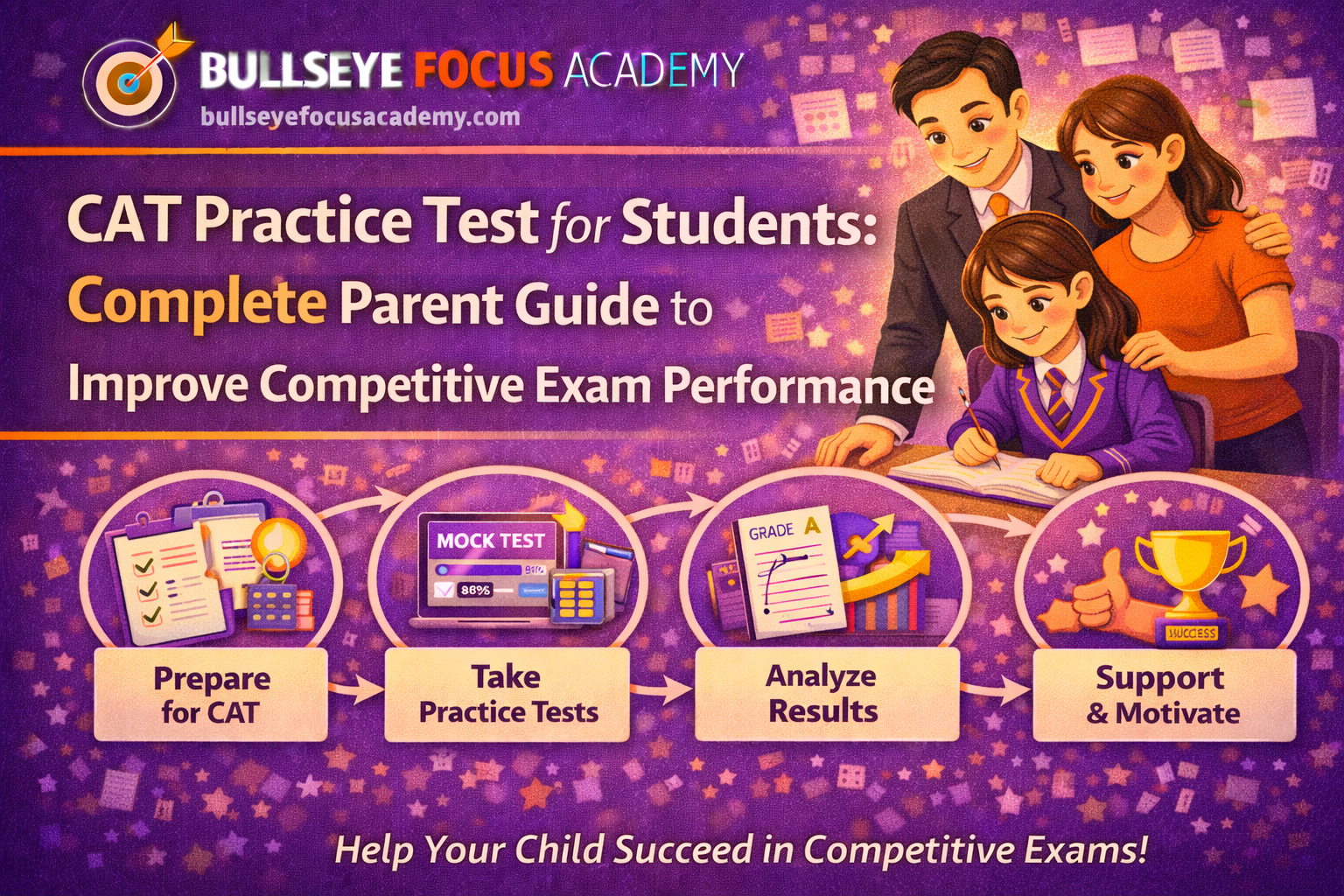
CAT Practice Test for Students: Complete Parent Guide to Improve Competitive Exam Performance
CAT Practice Test for Students: Why It Is Important
CAT practice test for students is one of the most effective ways to prepare children for competitive aptitude and reasoning-based examinations. Many parents search for CAT practice test for students because they want their child to develop strong analytical thinking, problem-solving abilities, and exam confidence from an early stage.
Today’s competitive academic environment requires students to do much more than memorise answers from textbooks. Children are expected to think logically, solve problems quickly, analyse patterns, and manage pressure effectively. These abilities are essential not only for competitive exams but also for long-term academic success.
This is where CAT practice test for students becomes extremely valuable. Regular practice allows children to become comfortable with aptitude-style questions while improving concentration, accuracy, and speed. Students who practise consistently often perform better because they understand how to manage time and approach different question types calmly.
Parents also search for CAT practice test for students because many competitive entrance exams include reasoning and aptitude-based sections. Early preparation helps children build strong foundations that support future academic goals.
When children regularly take CAT practice test for students, they improve confidence, reduce exam fear, and become more comfortable solving challenging questions under timed conditions.
What Is a CAT Practice Test and Why Parents Search for It
CAT practice test for students is designed to strengthen aptitude, logical reasoning, mathematics, analytical thinking, and problem-solving skills. These tests help students prepare for competitive academic environments by improving their ability to think critically and solve questions accurately within limited time.
Unlike traditional school exams that focus mostly on memorization, aptitude-based assessments measure how effectively students can process information and apply logic to solve problems. This is why many parents now prioritize reasoning and aptitude development from an early age.
Parents search for CAT practice test for students because they want to:
- Improve their child’s reasoning ability
- Develop faster problem-solving skills
- Increase confidence in competitive exams
- Strengthen mathematical thinking
- Identify weak areas early
- Improve concentration and accuracy
- Prepare children for future entrance exams
To understand how aptitude-based learning supports student development, parents can explore educational resources from Pearson at https://www.pearson.com for learning and assessment insights.
Benefits of CAT Practice Test for Students
Using CAT practice test for students regularly provides several long-term benefits that improve academic and competitive exam performance.
Improves Logical Reasoning Skills
Reasoning-based questions train children to think carefully and logically. This improves analytical thinking and problem-solving abilities.
Enhances Speed and Accuracy
Timed practice teaches students how to answer questions quickly while maintaining accuracy. This is extremely important in competitive exams.
Builds Confidence Under Pressure
Children become more comfortable with exam conditions through regular mock practice. Familiarity reduces fear and anxiety.
Identifies Strengths and Weak Areas
Practice tests help parents and students understand which topics need more attention and improvement.
Improves Concentration
Aptitude tests require strong focus. Regular practice improves a child’s ability to stay attentive for longer periods.
Encourages Independent Thinking
Students learn how to solve unfamiliar questions without depending entirely on memorised methods.
Supports Future Competitive Exams
Skills developed through CAT practice test for students are useful for many future entrance exams and academic assessments.
7 Effective Ways to Use CAT Practice Test for Students
Parents can help children achieve better results using these effective strategies.
Start Preparation Early
Starting early gives children enough time to build confidence gradually. Early preparation reduces stress and allows steady improvement.
Practice Under Timed Conditions
Timed practice improves speed, concentration, and time management skills. Students learn how to complete sections efficiently.
Analyse Mistakes Carefully
Reviewing incorrect answers is one of the most important parts of preparation. Children should understand why mistakes happened and learn the correct approach.
Focus on Weak Areas
Students should spend extra time improving weaker sections rather than only practising subjects they already enjoy.
Use Multiple Practice Tests
Different mock tests expose children to various question patterns and improve adaptability.
Encourage Daily Revision
Regular revision strengthens understanding and improves memory retention.
Maintain Consistency
Small daily practice sessions are more effective than irregular long study hours. Consistency leads to stronger long-term improvement.
For structured preparation and expert guidance, parents can explore https://bullseyefocusacademy.com/ and access learning programs at https://bullseyefocusacademy.com/shop/ to help children practise effectively.
How CAT Practice Test for Students Improves Academic Performance
CAT practice test for students does not only help with competitive exams. It also improves overall academic performance.
Better Problem-Solving Ability
Children become faster at analyzing questions and selecting correct solutions.
Improved Mathematical Thinking
Regular aptitude practice strengthens numerical understanding and calculation speed.
Stronger Decision-Making Skills
Students learn how to make quick and accurate decisions during timed exams.
Increased Confidence in School Exams
Children who develop strong reasoning skills often feel more confident during school assessments as well.
Better Study Habits
Regular practice encourages discipline, consistency, and structured learning routines.
Reduced Exam Stress
Students who practise regularly feel more prepared and experience less anxiety during important exams.
Common Mistakes Students Should Avoid
While preparing with CAT practice test for students, some mistakes can reduce improvement and performance.
Ignoring Time Management
Students sometimes focus only on solving questions correctly without improving speed.
Practising Without Reviewing Mistakes
Simply taking tests is not enough. Reviewing errors is essential for improvement.
Focusing Only on Easy Questions
Children should challenge themselves with different difficulty levels to improve overall ability.
Taking Long Gaps Between Practice Sessions
Irregular practice reduces consistency and slows progress.
Starting Preparation Too Late
Late preparation increases pressure and limits improvement opportunities.
Studying for Too Many Hours Without Breaks
Short focused sessions are more effective than long exhausting study hours.
Avoiding these mistakes helps children improve more effectively and confidently.
How Parents Can Support Their Child
Parents play a very important role in helping children succeed through CAT practice test for students.
Encourage Positive Learning
Children perform better when they feel motivated and supported rather than pressured.
Create a Distraction-Free Study Environment
A quiet and organised study space helps improve concentration.
Help Build a Consistent Routine
Daily routines improve discipline and learning habits.
Celebrate Small Achievements
Recognising improvement helps boost confidence and motivation.
Avoid Comparing Children
Every child learns differently. Comparisons can reduce confidence and increase stress.
Maintain Balance
Children need proper rest, exercise, and relaxation alongside study.
A supportive environment helps students stay confident, motivated, and emotionally balanced during preparation.
Online Learning Resources for Students
Parents can use trusted online learning platforms to strengthen preparation and improve reasoning skills.
Students can practise mathematics, reasoning, and problem-solving using https://www.khanacademy.org which provides interactive educational content.
Additional learning support and educational activities are also available on https://www.bbc.com/bitesize which helps children improve core academic skills.
These platforms help students strengthen understanding while making learning more engaging and interactive.
Why Mock Tests Are Essential for Competitive Exam Success
Mock tests are one of the most effective preparation tools because they simulate real exam pressure.
Benefits of regular mock testing include:
- Improved confidence
- Better time management
- Familiarity with exam structure
- Faster question-solving speed
- Reduced exam fear
- Stronger focus and concentration
- Better accuracy under pressure
Students who regularly practise mock exams usually perform more confidently during actual assessments.
FAQs
1. What is a CAT practice test for students?
CAT practice test for students is a mock aptitude and reasoning test designed to improve analytical thinking and problem-solving abilities.
2. How often should students take practice tests?
Students should practise regularly to improve confidence, speed, and accuracy over time.
3. Do practice tests improve reasoning ability?
Yes, regular practice strengthens logical thinking, concentration, and analytical skills.
4. Can students prepare at home?
Yes, children can prepare effectively at home using structured plans, mock tests, and proper guidance.
5. Are aptitude tests important for competitive exams?
Yes, aptitude and reasoning skills are essential for many competitive entrance exams and academic assessments.
6. At what age should children begin aptitude preparation?
Children can begin basic reasoning and aptitude practice from primary school level depending on their learning ability.
7. How can parents help children stay motivated?
Parents can motivate children by encouraging progress, maintaining routines, and creating a positive learning environment.
8. Are online aptitude practice programs effective?
Yes, structured online learning programs can provide flexible and effective preparation support.
Conclusion
CAT practice test for students is one of the best ways to improve reasoning skills, analytical thinking, confidence, and overall competitive exam readiness. Regular practice helps children become more comfortable solving logical and aptitude-based questions under timed conditions. It also improves concentration, accuracy, and decision-making skills, which are essential for academic success and future entrance examinations.
Students who consistently practise mock aptitude tests often perform better because they become familiar with exam patterns and learn how to manage time effectively. These practice tests also help identify weak areas early, allowing children to improve gradually without unnecessary pressure.
Parents who include CAT practice test for students in their child’s learning routine provide them with a strong academic advantage. Early preparation supports not only competitive exam performance but also long-term learning development, problem-solving ability, and confidence in school studies.
With structured guidance, regular practice, and the right educational support, students can strengthen their logical thinking, reduce exam stress, and achieve better academic performance. Consistency and encouragement from parents play an important role in helping children stay motivated, focused, and prepared for future academic challenges.