
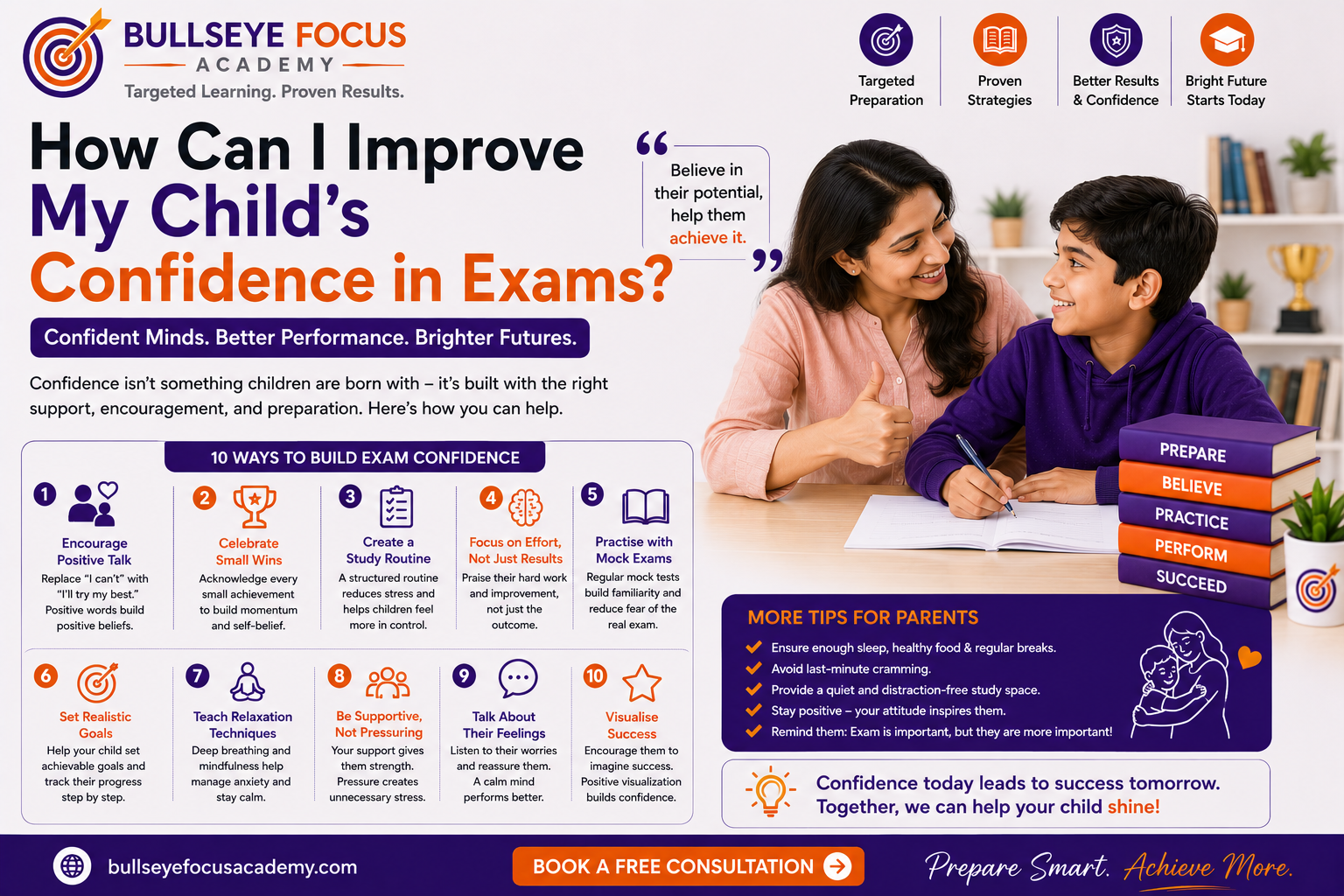
How Can I Improve My Child’s Confidence in Exams?
Exam preparation is not only about learning facts, completing worksheets, or getting high marks. A child can understand the subject well but still struggle when they feel nervous, worried, or unsure during an exam. Building Child’s Exam Confidence can help students approach tests with a calmer and more positive mindset. For parents preparing their children for the 11 Plus, confidence is especially important. The exam may involve timed questions, unfamiliar problems, and several different skills. Children need to believe that they can handle challenges, recover from mistakes, and keep working even when a question seems difficult.
The good news is that confidence can be developed gradually. Parents do not need to put extra pressure on children or expect perfect scores. Instead, they can create supportive routines, celebrate progress, practise exam skills, and help children understand that mistakes are a normal part of learning.
Why Is Child’s Exam Confidence Important?
Confidence can influence how children approach challenging questions and unfamiliar situations. A confident child is more likely to stay focused, attempt difficult questions, and continue working after making a mistake. Low confidence can have the opposite effect. A child may know the answer but hesitate, rush, become distracted, or give up too quickly. Strong Child’s Exam Confidence can help students approach challenging questions with a calmer and more positive attitude.
Confidence Helps Children Stay Calm
Exam pressure can make children feel nervous. A calm approach can strengthen Child’s Exam Confidence and allow them to read questions carefully and think before answering. Parents can help children become comfortable with timed practice and mock exams. This gradually makes exam conditions feel less unfamiliar and helps children approach tests with greater confidence.
Confidence Encourages Children to Try
Some children avoid difficult questions because they are afraid of being wrong. Positive encouragement can strengthen Child’s Exam Confidence and help them understand that attempting a difficult question is valuable. Even an incorrect answer can show what needs more practice, helping children learn from mistakes and become more comfortable with challenging questions.
Confidence Supports Independent Learning
Children who believe they can improve are more likely to take responsibility for their preparation. Building Child’s Exam Confidence can encourage them to practice independently, review mistakes, ask for help when needed, and take an active role in their learning journey.
They may become more willing to:
- Complete practice questions independently
- Review mistakes
- Ask for help
- Try challenging topics
- Track their own progress
These habits can support children throughout their education.
What Causes Low Exam Confidence in Children?
Before trying to improve confidence, parents should consider why their child may feel uncertain. Every child is different, but several common factors can affect Child’s Exam Confidence, including fear of mistakes, pressure to achieve high scores, comparisons with other children, and a lack of familiarity with exam conditions.
Fear of Making Mistakes
Some children believe that getting an answer wrong means they are not good at the subject. This can affect Child’s Exam Confidence and make them afraid to attempt difficult questions. Parents can change this mindset by explaining that mistakes provide useful information. Reviewing an incorrect answer can help a child understand what to practise next and build confidence gradually.
Pressure to Get High Scores
Constantly focusing on marks can make preparation stressful and negatively affect Child’s Exam Confidence. A child who hears that they must achieve a certain score every time may become worried about disappointing their parents. Instead, focus on improvement. If a child moves from 55% to 65%, that progress should be recognised and celebrated.
Comparing Children With Others
Comparing a child with siblings, classmates, or friends can damage Child’s Exam Confidence. Children develop skills at different speeds. One student may be excellent at maths while another may have stronger reading skills. Parents should compare current performance with previous performance rather than comparing their child with somebody else. This helps children recognise their own progress and stay motivated.
Lack of Exam Practice
Sometimes children feel nervous simply because they have not experienced exam-style conditions. Regular practice can make the process more familiar and strengthen Child’s Exam Confidence. This is particularly useful for children preparing for the 11 Plus, where timing and question formats can be unfamiliar at first. Mock exams and timed exercises can help children feel more prepared and comfortable.
How Can Parents Build Child’s Exam Confidence?
Parents have an important role in creating a positive preparation environment. Confidence does not usually develop after one motivational conversation. It grows through repeated experiences of learning, practicing, improving, and overcoming challenges. Building Child’s Exam Confidence takes time, so parents should focus on steady progress rather than expecting immediate results.
Set Small and Achievable Goals
Large goals can seem overwhelming. Instead of telling a child to “get a high score,” create smaller targets.
For example:
- Complete one reading exercise
- Improve accuracy in multiplication
- Learn five new vocabulary words
- Complete a timed reasoning exercise
- Review mistakes from a previous paper
Small achievements provide regular opportunities for children to experience success.
Praise Effort and Progress
Praise should focus on effort, improvement, and good learning habits.
Instead of only saying, “You got 80%,” parents could say: “You worked carefully through the difficult questions.”
This helps children understand that their actions contribute to improvement.
Avoid Excessive Pressure
Children need to know that their parents care about their education without feeling that their value depends on exam results. Regular encouragement is more useful than constant reminders about competition. A calm home environment can make preparation feel manageable.
Create a Positive 11 Plus Study Routine
A consistent routine can help children feel more prepared. Instead of studying for long hours occasionally, encourage short and focused sessions throughout the week. A consistent study routine can strengthen Child’s Exam Confidence by helping students know what to expect from their preparation.
Keep Study Sessions Manageable
Long study sessions can cause tiredness and frustration. Depending on the child’s age, ability, and preparation stage, parents can divide learning into manageable activities. For example, one session could focus on English comprehension while another focuses on maths or reasoning.
Include Regular Breaks
Breaks allow children to rest and return to their work with better concentration. Regular breaks can also support Child’s Exam Confidence by preventing children from feeling overwhelmed or exhausted during preparation. A balanced routine with focused study sessions, rest, and enjoyable activities can help children stay motivated and approach learning more positively.
A study routine should include time for:
- Learning
- Practice
- Breaks
- Reading
- Relaxation
- Play
A balanced routine is more sustainable than constant studying.
Keep the Routine Predictable
Children often feel more comfortable when they know what to expect. A simple weekly timetable can show which subjects will be practiced on each day. This can reduce last-minute preparation and help children feel more organized.
Use Mock Exams to Build Confidence
Mock exams are valuable for developing Child’s Exam Confidence because they give children the opportunity to experience exam-style conditions before the actual assessment. Children can practise working under time limits, reading questions carefully, and moving between different types of problems. Regular mock exams can play an important role in developing Child’s Exam Confidence because children become more familiar with exam conditions.
Start With Untimed Practice
If a child is very nervous, immediately starting with full-timed papers may increase pressure. Begin with shorter exercises and gradually build Child’s Exam Confidence through manageable practice. Once the child becomes comfortable, introduce time limits gradually. This approach helps children become familiar with exam conditions without feeling overwhelmed and allows them to develop better timing skills.
Introduce Full Mock Exams Gradually
As preparation progresses, children can complete complete mock exams under realistic conditions.
This helps them understand what it feels like to:
- Sit for an extended period
- Work through multiple questions
- Manage time
- Stay focused
- Review answers
Review the Results Positively
The purpose of a mock exam should not simply be to identify a score. Instead, use the results to identify strengths and areas for improvement while building Child’s Exam Confidence. Reviewing results positively helps children understand what they are doing well, recognise which topics need more practice, and approach future mock exams with greater confidence.
Ask questions such as:
- Which questions felt easy?
- Which questions were difficult?
- Did you run out of time?
- Which topic needs more practice?
- What did you learn from this paper?
This turns mistakes into practical learning opportunities. Parents looking for structured 11 Plus practice can explore Exam Plus Mock for additional mock exam resources.
Teach Children How to Handle Difficult Questions
One difficult question should not ruin an entire exam. Children should learn that it is normal to encounter questions they cannot answer immediately.
Teach the Move-On Strategy
If a question is taking too long, children can move on when the exam rules allow it and return later. This prevents one difficult question from using too much time.
Encourage Careful Reading
Many mistakes happen because children rush. Teach them to read the complete question before choosing an answer. This is especially important in English comprehension, maths word problems, and reasoning questions.
Practise Staying Positive
Children can learn simple internal reminders such as:
- “I can try this.”
- “I can move on and come back.”
- “One difficult question does not matter.”
- “I have practised this before.”
Positive self-talk can help children remain calm when something feels difficult.
Help Your Child Learn From Mistakes
Mistakes are a normal part of preparation. The way parents respond to mistakes can have a significant impact on confidence. Reviewing mistakes positively can strengthen Child’s Exam Confidence and help children understand that improvement comes through practice.
Avoid Negative Reactions
If every wrong answer results in criticism, children may become afraid of making mistakes.
Instead, ask: “What made this question difficult?”
This encourages children to think about the process rather than simply feeling disappointed.
Keep a Mistake Log
A simple mistake log can help children recognise patterns and strengthen Child’s Exam Confidence. By recording common errors, children can identify which topics need more practice and understand how they are improving. Reviewing mistakes regularly also helps them feel more prepared and confident when facing similar questions in future exams.
It could include:
| Area | Mistake | Reason | Next Step |
|---|---|---|---|
| Maths | Incorrect calculation | Rushed | Practise carefully |
| English | Misread passage | Read too quickly | Slow down |
| Reasoning | Missed pattern | Needed more practice | Complete similar questions |
Reviewing this information regularly can show children how much they are improving.
Encourage Reading to Improve Confidence
Reading is an important part of 11 Plus preparation. Regular reading can help children develop vocabulary, comprehension, concentration, and familiarity with different writing styles.
Make Reading Part of Everyday Life
Children do not always need to read exam materials.
Encourage them to explore:
- Fiction
- Non-fiction
- Newspapers suitable for children
- Magazines
- Biographies
- Age-appropriate articles
The goal is to make reading a normal and enjoyable activity.
Discuss What Your Child Reads
Ask your child about the story or article. Questions such as “What do you think will happen next?” or “Why do you think the character did that?” encourage deeper thinking. This can support comprehension skills while keeping reading conversational.
Make Learning Enjoyable
Preparation should not feel like punishment. When children associate learning with constant pressure, motivation may decrease and Child’s Exam Confidence can suffer. Parents can make preparation more positive by including enjoyable activities, short breaks, encouraging feedback, and achievable goals. A supportive learning environment can help children stay motivated and feel more confident.
Use Games and Challenges
Educational games can make practice more engaging. Parents can introduce vocabulary games, mental maths challenges, puzzles, and reasoning activities. These activities can provide useful practice without making every learning experience feel like an exam.
Allow Children to Choose Sometimes
Giving children limited choices can increase their sense of control.
For example: “Would you like to do English comprehension or maths first?”
This simple choice can make children more willing to participate.
Build Confidence Through Consistent Practice
Confidence develops when children repeatedly experience themselves improving. A child may initially struggle with a particular type of question. After practising it several times, the same question may become easier, helping build Child’s Exam Confidence. Recognising this progress can encourage children to keep practising and approach challenging questions with a more positive mindset.
Track Improvement
Keep a record of mock exam scores, practice results, or completed topics. The purpose is not to create pressure. It is to help children see evidence of their progress.
For example:
Week 1: 58%
Week 4: 66%
Week 8: 74%
Seeing improvement can reinforce the idea that consistent effort produces results.
Celebrate Small Wins
Celebrate achievements such as:
- Completing a difficult exercise
- Improving accuracy
- Finishing a timed paper
- Learning new vocabulary
- Correcting repeated mistakes
Small successes can contribute significantly to Child’s Exam Confidence.
Teach Healthy Exam-Day Habits
Preparation for confidence should continue beyond academic practice. Children should know what to expect on exam day. Good preparation and healthy exam-day habits can support Child’s Exam Confidence and help children approach the assessment calmly.
Prepare Everything in Advance
Avoid unnecessary stress by preparing required items the night before. Depending on the exam rules, this may include stationery, clothing, snacks, water, and other permitted items.
Encourage Good Sleep
Children are more likely to concentrate when they are well rested. Avoid encouraging late-night revision immediately before an important exam.
Provide a Calm Morning
Keep the morning simple and positive. Avoid last-minute intensive revision or discussions that increase pressure. A reassuring message can be more useful than another worksheet.
What Should Parents Avoid When Building Exam Confidence?
Parents usually want to help, but some approaches can unintentionally increase stress and affect Child’s Exam Confidence. Constant testing, comparing children, focusing only on scores, or creating last-minute pressure can make preparation feel overwhelming. A supportive approach that values effort, progress, and consistent practice can help children feel more comfortable and confident.
Avoid Constant Testing
Not every interaction needs to become an opportunity to test your child. Allow time for normal family activities and relaxation.
Avoid Focusing Only on Scores
Scores are useful for measuring progress, but they are not the only measure of preparation. Confidence, understanding, speed, accuracy, and independence are also important.
Avoid Negative Comparisons
Statements such as “Your friend is already doing better” can damage confidence. Instead, encourage children to focus on their own progress.
Avoid Last-Minute Pressure
Intensive revision immediately before an exam can increase anxiety. A consistent preparation routine is usually more helpful.
When Should Parents Consider Additional Support?
Some children may need additional support during their preparation. This does not mean they are incapable of succeeding. The right support can strengthen Child’s Exam Confidence by helping children understand difficult topics, overcome challenges, and feel more secure in their preparation. Parents can consider targeted resources, school guidance, or personalised support when appropriate.
Additional support may be useful when a child:
- Repeatedly struggles with a particular topic
- Has difficulty staying motivated
- Needs more explanation
- Finds timed practice particularly stressful
- Is unsure how to structure independent study
Parents can consider appropriate resources, school guidance, targeted learning support, or tutoring depending on their child’s individual needs. The most important thing is to identify what the child actually needs rather than automatically assuming that more study is the answer.
A Simple Weekly Plan for Building Exam Confidence
A simple routine can combine academic practice with confidence-building activities. This approach can strengthen Child’s Exam Confidence by giving children regular opportunities to practise, recognise their progress, and become familiar with exam-style tasks. A balanced routine can include study sessions, mock exams, reading, breaks, and enjoyable activities without making preparation feel overwhelming.
Monday
Complete a short maths exercise and review mistakes.
Tuesday
Practise English comprehension and spend time reading for pleasure.
Wednesday
Complete verbal or non-verbal reasoning exercises.
Thursday
Review difficult topics from earlier sessions.
Friday
Complete a short timed activity.
Weekend
Complete a mock exam when appropriate and review the results calmly.
The exact schedule should be adjusted according to the child’s age, exam date, current ability, and other commitments. Parents looking for additional learning resources can explore the Bullseye Focus Academy shop to find suitable academic support and preparation options for their children.
Frequently Asked Questions About Child’s Exam Confidence
How can I help my child feel less nervous about exams?
Create a calm preparation routine and introduce exam-style practice gradually. Encourage your child to talk about their worries and reassure them that feeling nervous is normal. Mock exams, positive feedback, regular breaks, and realistic preparation can strengthen Child’s Exam Confidence and help make the actual exam feel more familiar and manageable.
Why does my child lose confidence after making mistakes?
Some children interpret mistakes as evidence that they are not capable. Help them understand that mistakes show which areas need more practice. Reviewing errors calmly can strengthen Child’s Exam Confidence, while identifying what went wrong and explaining what can be done differently next time. This approach turns mistakes into useful learning opportunities and encourages children to keep improving.
Should I focus on my child’s exam scores?
Scores are useful for measuring progress, but they should not be the only focus. Parents should also consider accuracy, understanding, speed, independence, and confidence. Celebrating improvement can strengthen Child’s Exam Confidence and encourage children to keep practising without making them feel that their self-worth depends on achieving a particular score.
Are mock exams good for building exam confidence?
Yes. Mock exams can help children become familiar with time limits, question formats, and exam conditions. They also allow parents to identify areas that need improvement and strengthen Child’s Exam Confidence. Start with manageable practice and gradually introduce realistic conditions so that children become more comfortable without feeling overwhelmed.
How often should my child practise for the 11 Plus?
There is no single schedule that works for every child. Regular, focused practice is generally more useful than occasional long sessions. Parents should create a realistic routine that includes academic practice, reading, revision, mock exams, breaks, and free time. This balanced approach can strengthen Child’s Exam Confidence while helping children prepare consistently without feeling overwhelmed.
What should I say when my child gets a low mock exam score?
Stay positive and avoid criticism. Ask your child which parts felt difficult and review the paper together. A low score can show which areas need attention and help improve Child’s Exam Confidence by showing children that mistakes are opportunities to learn. Focus on what can be improved rather than treating the result as a prediction of the child’s final performance.
Can reading improve my child’s exam confidence?
Regular reading can strengthen vocabulary, comprehension, concentration, and familiarity with different writing styles. As children become better at understanding passages and answering questions, they may feel more capable, which can improve Child’s Exam Confidence. Choosing interesting books and discussing them can make reading enjoyable rather than turning it into another stressful task.
How can I stop my child from comparing themselves with others?
Encourage your child to compare their current performance with their own previous results instead. This can strengthen Child’s Exam Confidence by helping them recognise personal progress and understand that every child develops skills at a different pace. Avoid using classmates or siblings as benchmarks, as this can create unnecessary pressure and reduce motivation.
Should I use rewards to improve exam motivation?
Small rewards can sometimes encourage children, but they should not become the only reason a child studies. Praise effort, persistence, improvement, and good learning habits to strengthen Child’s Exam Confidence. Children should gradually develop internal motivation and understand that regular practice helps them become more capable, independent, and confident when approaching exams.
What if my child is still anxious despite practising?
If anxiety continues despite regular preparation, listen to your child and identify what is causing the concern. Reducing unnecessary pressure and providing reassurance can support Child’s Exam Confidence. Speak with appropriate school or educational professionals if needed. A supportive approach can help determine whether the child needs changes to their study routine or additional guidance.
Conclusion: Helping Your Child Build Lasting Exam Confidence
Building Child’s Exam Confidence is a gradual process. Children do not become confident simply because they complete more worksheets. They become confident when they experience progress, understand how to handle mistakes, practise realistic exam situations, and know that their parents support them. The best approach is to create a balanced preparation routine. Combine regular academic practice with reading, mock exams, breaks, encouragement, and enjoyable activities.
Parents should focus on progress rather than perfection. A child who makes mistakes, learns from them, and keeps trying is developing an important skill that extends beyond the 11 Plus. With patience, consistency, and the right support, Child’s Exam Confidence can grow steadily, helping children approach exams with greater confidence and a more positive attitude towards learning.
If your child needs personalised guidance or you would like to discuss suitable preparation options, you can contact Bullseye Focus Academy for further support.