Common Mistakes Parents Make During 11 Plus Preparation (And How to Avoid Them)
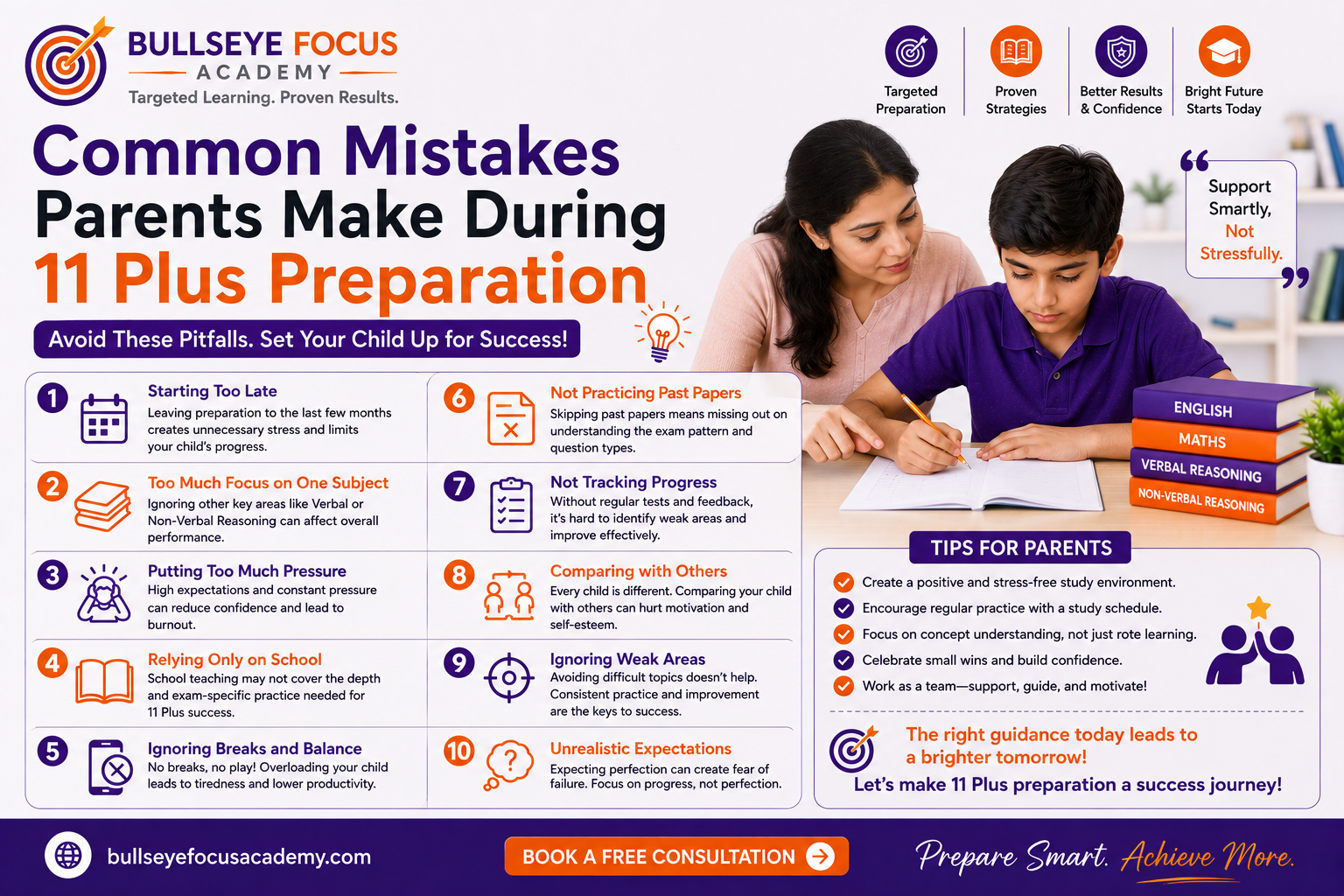
Preparing for the 11 Plus examination can be an emotional and challenging journey for both parents and children. Most parents want to provide the best possible support, but even with good intentions, certain preparation habits can create unnecessary stress and reduce a child’s confidence. Following effective 11 Plus Tips helps families avoid these common problems and create a healthier, more productive preparation experience.
Many parents focus heavily on practice papers, tuition, and revision schedules, but successful preparation is about much more than completing as many questions as possible. Children need confidence, motivation, balance, and consistent support. When preparation becomes too intense or unstructured, students may begin to feel overwhelmed, anxious, or discouraged.
Understanding the mistakes that other families commonly make allows parents to avoid unnecessary pressure and focus on strategies that genuinely help children improve. Small changes in approach can make a significant difference to both academic performance and emotional well-being.
Families looking for structured learning support can explore: https://bullseyefocusacademy.com/
Practice materials and preparation resources are available at: https://bullseyefocusacademy.com/shop/
These practical 11 Plus Tips help parents create a balanced preparation plan that supports both academic progress and their child’s confidence.
Why Parents Often Feel Pressured
The 11 Plus examination is highly competitive, and many parents naturally worry about giving their child the best possible chance of success. This pressure can lead families to compare themselves with others, follow unrealistic study schedules, or focus too heavily on scores.
Common sources of pressure include:
Hearing about other children starting preparation early.
Comparing mock exam results.
Reading online discussions about grammar school admissions.
Worrying about limited school places.
Feeling responsible for their child’s success.
One of the most important 11 Plus Tips is to remember that every child develops at a different pace. Comparing preparation journeys rarely leads to positive outcomes. Following reliable 11 Plus Tips helps families avoid unnecessary stress and focus on preparation methods that genuinely improve learning.
Mistake 1: Starting Preparation Too Late
One of the most common errors is waiting until a few months before the examination to begin structured preparation.
Late preparation often leads to:
Increased stress.
Rushed learning.
Limited time to improve weak areas.
Reduced confidence.
Poor exam technique.
Children need time to develop vocabulary, reasoning skills, mathematical understanding, and familiarity with exam formats. Most education specialists recommend beginning gradual preparation during Year 4 or early Year 5. This does not mean intensive daily revision. Early preparation should focus on reading, problem-solving, and building strong learning habits.
Mistake 2: Starting Too Early
Surprisingly, starting too early can also be a problem.
Some families begin intensive preparation several years before the examination. This can lead to:
Burnout.
Loss of motivation.
Increased anxiety.
Negative attitudes towards learning.
Fatigue before the exam year even begins.
Young children should still have plenty of time for play, hobbies, sports, and social activities. Effective 11 Plus Tips encourage gradual skill development rather than constant testing.
Mistake 3: Focusing Only on Practice Papers
Practice papers are useful, but they should not become the entire preparation program. Some parents believe that completing large numbers of papers automatically guarantees success. In reality, children often make the same mistakes repeatedly if they do not understand the underlying concepts.
A balanced approach should include:
Reading.
Vocabulary development.
Mathematics revision.
Verbal reasoning.
Non-verbal reasoning.
Mock exams.
Review of mistakes.
Quality learning is usually more valuable than simply increasing the number of papers completed. One of the most valuable 11 Plus Tips is to combine practice papers with regular revision, reading, and detailed mistake analysis.
Mistake 4: Ignoring Vocabulary Development
Vocabulary is one of the most important factors in many 11 Plus examinations, particularly verbal reasoning and English sections.
Children with strong vocabulary skills often find it easier to:
Understand instructions.
Solve word-based reasoning questions.
Interpret comprehension passages.
Write more effectively.
Learn new concepts quickly.
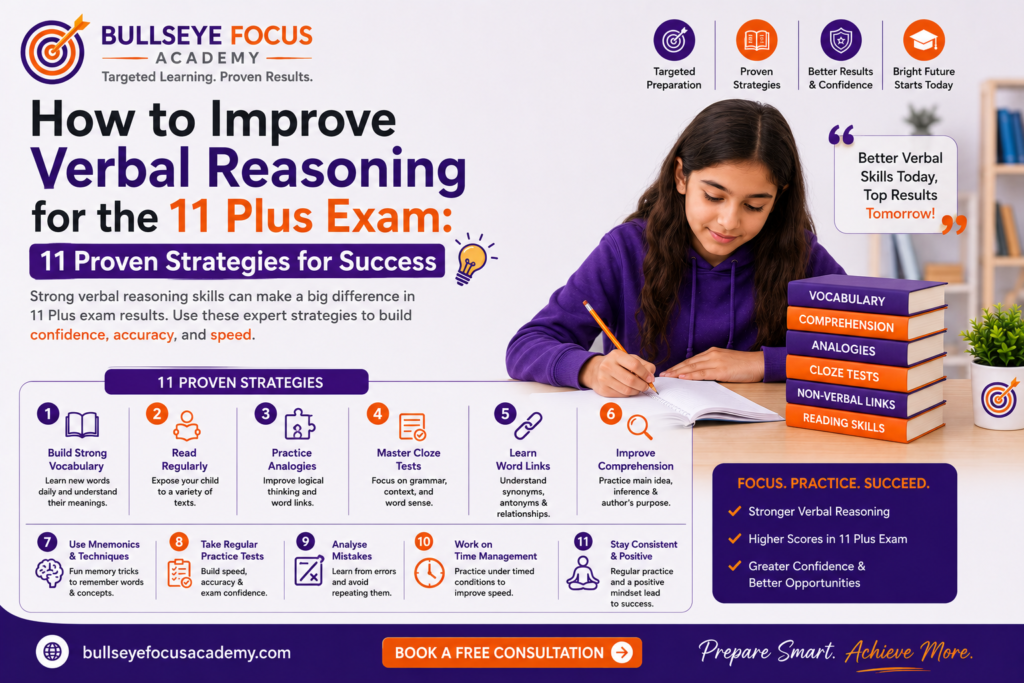
One of the most effective 11 Plus Tips is to encourage daily reading and regular discussion of unfamiliar words. Vocabulary growth happens gradually, so consistent exposure is essential.
Mistake 5: Comparing Children
Parents sometimes compare their child’s progress with friends, classmates, or siblings. This can damage confidence and create unnecessary pressure. Every child has different strengths, learning styles, and rates of development. A student who progresses slowly at first may make rapid improvements later.
Instead of comparing children, parents should focus on:
Personal improvement.
Effort.
Confidence.
Consistency.
Progress over time.
Celebrating individual progress is far more motivating than measuring performance against others.
Mistake 6: Creating Excessive Pressure
Children often perform worse when they feel that every practice paper determines their future.
Signs of excessive pressure include:
Frequent tears during revision.
Fear of making mistakes.
Loss of interest in learning.
Sleep difficulties.
Irritability.
Avoiding study sessions.
Good 11 Plus Tips encourage parents to create a supportive environment where mistakes are viewed as opportunities to learn rather than failures.
Mistake 7: Ignoring Emotional Well-Being
Academic preparation is important, but emotional well-being is equally essential.
Children need:
Adequate sleep.
Physical activity.
Family time.
Relaxation.
Social interaction.
Time away from study.
A tired or anxious child is unlikely to perform at their best. Balanced routines usually lead to better concentration, memory, and motivation.
Mistake 8: Not Reviewing Mistakes Properly
Many students complete practice papers, check the answers, and immediately move on to the next paper. This approach limits improvement.
After every practice session, children should:
Identify incorrect answers.
Understand why they were wrong.
Learn the correct method.
Practise similar questions.
Record recurring mistakes.
Reviewing mistakes is one of the most valuable 11 Plus Tips because it turns errors into learning opportunities.
How Parents Can Create a Positive Study Environment
A calm and organized study space can make revision much more effective.
Helpful ideas include:
Keeping the study area tidy.
Reducing distractions.
Providing necessary materials.
Maintaining a regular study time.
Encouraging short breaks.
Children generally concentrate better when they know exactly when and where study sessions will take place. Consistently applying simple 11 Plus Tips allows parents to build a positive learning environment where children feel encouraged to improve every week.
The Importance of Realistic Expectations
Every child has a unique combination of strengths and challenges.
Realistic expectations help children:
Stay motivated.
Feel supported.
Take healthy risks.
Learn from mistakes.
Develop confidence.
Parents should focus on helping their child achieve their personal best rather than expecting perfection.
For additional preparation guidance, families can explore personalised learning support through: https://bullseyefocusacademy.com/contact-us/
Understanding these common mistakes allows parents to make more informed decisions and create a preparation journey that supports both academic progress and emotional well-being.
Mistake 9: Relying Too Much on Tuition
Many parents believe that enrolling their child in tuition alone guarantees success. While tuition can provide valuable guidance, it should support—not replace—independent learning.
Children also need time to:
- Revise independently.
- Read regularly.
- Complete homework carefully.
- Review mistakes.
- Practice exam techniques.
One of the best 11 Plus Tips is to encourage children to take responsibility for their own learning. Students who become independent learners often perform more confidently during the examination.
Mistake 10: Taking Too Many Mock Exams
Mock examinations are an excellent preparation tool, but completing too many without reviewing performance can become overwhelming.
Instead of focusing on quantity, parents should ensure every mock exam is followed by:
- Careful review of mistakes.
- Revision of weaker topics.
- Discussion of time management.
- Positive feedback.
- A clear improvement plan.
Effective 11 Plus Tips recommend using mock exams to measure progress rather than simply collecting scores.
Mistake 11: Ignoring Time Management
Many students understand the questions but struggle to finish the paper within the allocated time.
Parents can help children improve time management by encouraging them to:
- Complete timed practice sessions.
- Move on from difficult questions.
- Return to challenging questions later.
- Monitor their pace during practice.
- Practise full-length mock exams.
Developing these habits before the real examination helps children remain calm and organized.
Mistake 12: Expecting Perfection
Some parents unintentionally make children feel that anything less than a perfect score is disappointing. Perfection is not necessary for success.
Children benefit much more when parents celebrate:
- Improvement.
- Effort.
- Persistence.
- Confidence.
- Positive study habits.
One of the most valuable 11 Plus Tips is to praise progress rather than perfection.
Mistake 13: Forgetting to Celebrate Small Successes
Preparing for the 11 Plus examination can take many months. If every study session focuses only on what still needs improvement, children may lose motivation.
Parents should celebrate achievements such as the following:
- Learning new vocabulary.
- Improving mock exam scores.
- Completing difficult topics.
- Better time management.
- Increased confidence.
Recognizing small successes helps children remain motivated throughout their preparation.
How Parents Can Support Their Child Effectively
Parents do not need to know every exam question to provide valuable support.
Helpful strategies include:
- Listening patiently.
- Encouraging daily reading.
- Maintaining a consistent routine.
- Providing healthy meals.
- Ensuring adequate sleep.
- Creating a calm learning environment.
- Offering reassurance before mock exams.
Children often perform better when they feel supported rather than pressured.
Creating a Balanced Weekly Study Routine
Following a structured timetable prevents last-minute revision and reduces stress.
Monday
- English reading
- Vocabulary practice
Tuesday
- Mathematics revision
- Mental arithmetic
Wednesday
- Verbal Reasoning practice
Thursday
- Non-Verbal Reasoning exercises
Friday
- Review previous mistakes
- Revise weaker topics
Saturday
- Timed practice paper
Sunday
- Mock examination
- Review answers
- Relaxation and family time
This balanced approach allows children to make steady progress without becoming overwhelmed.
Signs That Preparation Is Going Well
Parents often wonder whether their child is on the right track.
Positive signs include the following:
- Increased confidence.
- Better concentration.
- Improved mock exam scores.
- Greater independence.
- Stronger vocabulary.
- Better time management.
- Positive attitude towards revision.
Progress is not always measured by scores alone. Confidence and consistency are equally important indicators. Parents who follow effective 11 Plus Tips often notice gradual improvements in confidence, concentration, and independent learning habits.
Why Every Child’s Journey Is Different
Every family follows a unique preparation journey. Some children improve quickly, while others make gradual progress over several months.
Parents should remember the following:
- Learning speeds vary.
- Confidence develops differently.
- Strengths vary between subjects.
- Improvement is rarely perfectly consistent.
One of the most important 11 Plus Tips is to focus on long-term development instead of comparing progress with other families.
Personalized preparation makes a difference
No single study plan works for every child. Some students need additional vocabulary support. Others require more practice with reasoning or mathematics. Personalized preparation allows children to concentrate on areas that need the greatest improvement while maintaining confidence in stronger subjects.
Families looking for structured preparation can explore:
https://bullseyefocusacademy.com/
Practice resources and learning programmes are available at:
https://bullseyefocusacademy.com/shop/
Parents seeking personalised advice can contact:
https://bullseyefocusacademy.com/contact-us/
For official information about educational assessments, parents can also visit:
https://www.gl-assessment.co.uk/
Every family can benefit from personalized 11 Plus Tips that match their child’s learning style, strengths, and areas for improvement.
FAQs
What are the biggest mistakes parents make during 11 Plus preparation?
Some of the most common mistakes include starting preparation too late, creating excessive pressure, comparing children with others, ignoring emotional well-being, relying only on practice papers, and not following effective 11 Plus Tips that encourage balanced learning and consistent revision.
How can parents support their child during 11 Plus preparation?
Parents can support children by following practical 11 Plus Tips, including creating a structured study routine, encouraging daily reading, celebrating progress, reviewing mistakes together, maintaining healthy routines, and providing reassurance throughout the preparation process.
Should parents use mock exams regularly?
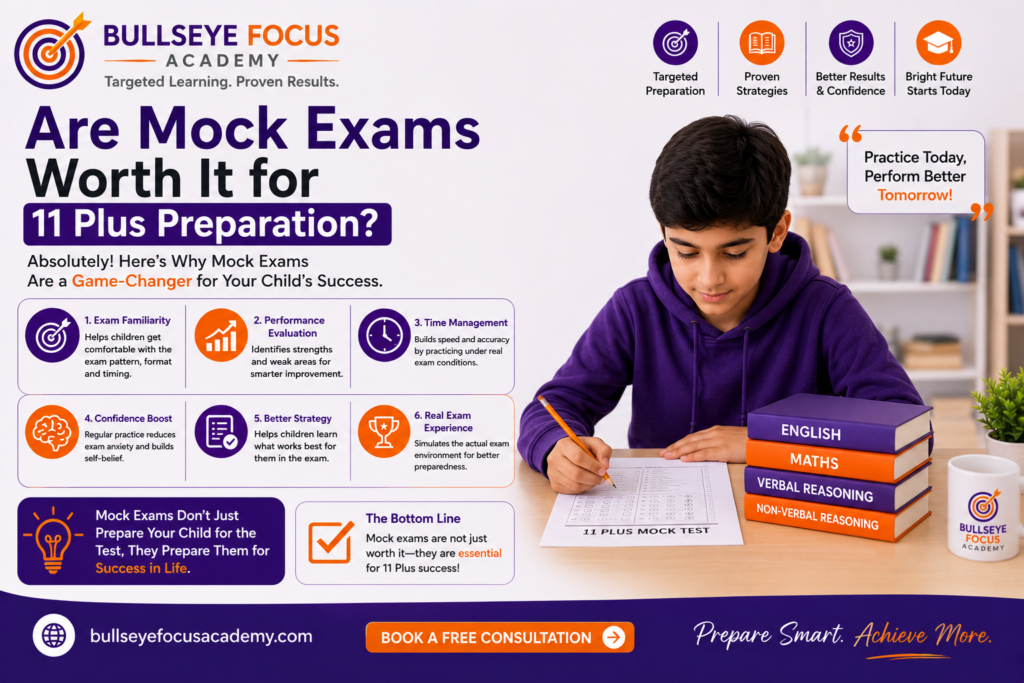
Yes. Mock examinations are an important part of effective 11 Plus Tips because they improve confidence, time management, and familiarity with real exam conditions. However, each mock exam should be followed by careful review and targeted revision.
How much revision is enough?
There is no fixed amount of revision that suits every child. Effective 11 Plus Tips recommend regular, consistent study sessions combined with breaks, hobbies, and family time instead of long periods of intensive revision.
Is confidence important during 11 Plus preparation?
Absolutely. Following positive 11 Plus Tips helps children develop confidence alongside academic knowledge. Confident students are often better able to manage exam pressure, remain focused, and perform consistently during the examination.
Conclusion
Preparing for the 11 Plus examination is not simply about completing practice papers or achieving high mock exam scores. It is about helping children build confidence, develop strong study habits, and enjoy learning while preparing for one of the most important stages of their education. By following practical 11 Plus Tips, parents can avoid common mistakes such as creating unnecessary pressure, comparing children with others, relying too heavily on tuition, or neglecting emotional well-being.
A balanced preparation plan that includes regular reading, vocabulary development, reasoning practice, mathematics revision, mock examinations, and careful review of mistakes gives children the best opportunity to succeed. Equally important is creating a positive home environment where effort is recognised, progress is celebrated, and mistakes are treated as valuable learning experiences.
Every child’s journey is different, and there is no single path to success. With patience, encouragement, consistent preparation, and the right 11 Plus Tips, parents can help their children approach the examination with confidence, resilience, and the skills needed not only for the 11 Plus exam but for future academic success as well. These 11 Plus Tips are designed to help parents guide their children through preparation with patience, consistency, and realistic expectations.
By following practical 11 Plus Tips, families can help children approach the 11 Plus examination with confidence, resilience, and the skills needed for long-term academic success.