How to Improve Non-Verbal Reasoning for the 11 Plus Exam: 11 Proven Strategies for Success
Preparing for the 11 Plus examination involves much more than studying English and Mathematics. Many grammar schools and selective independent schools also assess 11 Plus Non-Verbal Reasoning, which measures a child’s ability to recognise visual patterns, solve logical problems, and think critically without relying on language. For many students, this section of the exam feels unfamiliar because it focuses on visual thinking rather than knowledge learned in the classroom.
Parents often ask whether 11 Plus Non-Verbal Reasoning can be improved through practice. The answer is yes. Like any other academic skill, non-verbal reasoning develops through consistent practice, structured learning, and exposure to different question types. Children who understand how these questions work and regularly practise under timed conditions usually become more confident and accurate. Unlike English comprehension or mathematics, non-verbal reasoning does not depend on vocabulary or calculation skills. Instead, it tests how well students analyse shapes, identify patterns, understand relationships between images, and solve visual puzzles. These skills are valuable because they demonstrate logical thinking, problem-solving ability, and the capacity to learn new concepts quickly.
Many children initially struggle because they have never encountered this style of assessment before. However, with the right preparation plan and regular practice, students often make rapid progress. Parents who support structured learning and maintain a positive environment can help children approach the examination with confidence.
What Is 11 Plus Non-Verbal Reasoning?
11 Plus Non-Verbal Reasoning assesses a student’s ability to solve problems using visual information rather than written language.
Instead of reading long passages or solving mathematical calculations, students analyse the following:
- Shapes
- Symbols
- Diagrams
- Patterns
- Images
- Rotations
- Sequences
The examination measures logical thinking, observation, and problem-solving skills. Students must identify relationships between visual objects and determine the correct answer within a limited amount of time. Because many questions involve unfamiliar images, success depends on reasoning ability rather than memorised knowledge.
Why Is Non-Verbal Reasoning Important?
Grammar schools use 11 Plus Non-Verbal Reasoning to assess how children think when solving unfamiliar problems.
These questions measure important skills, such as:
- Logical reasoning
- Pattern recognition
- Visual analysis
- Problem-solving
- Attention to detail
- Critical thinking
These abilities support learning across many academic subjects, including mathematics, science, technology, and engineering. Strong reasoning skills also help students adapt more easily to new challenges throughout their education.
Common Types of Non-Verbal Reasoning Questions
Parents often ask what kinds of questions appear in 11 Plus Non-VerVerbal Reasoning examinations.
Although formats vary slightly between examination providers, common question types include:
- Shape sequences
- Rotating figures
- Mirror images
- Similar shapes
- Hidden shapes
- Cube problems
- Symmetry
- Pattern completion
- Shape transformations
- Matching diagrams
- Visual analogies
Students become more confident when they regularly practise a wide variety of question styles.
Why Students Find Non-Verbal Reasoning Difficult
Many children find 11 Plus Non-Verbal Reasoning challenging because it is very different from schoolwork.
Common reasons include:
- Unfamiliar question formats
- Limited practice
- Difficulty recognising patterns
- Poor observation skills
- Time pressure
- Lack of confidence
- Rushing through questions
Fortunately, all of these areas can improve through regular practice and effective preparation.
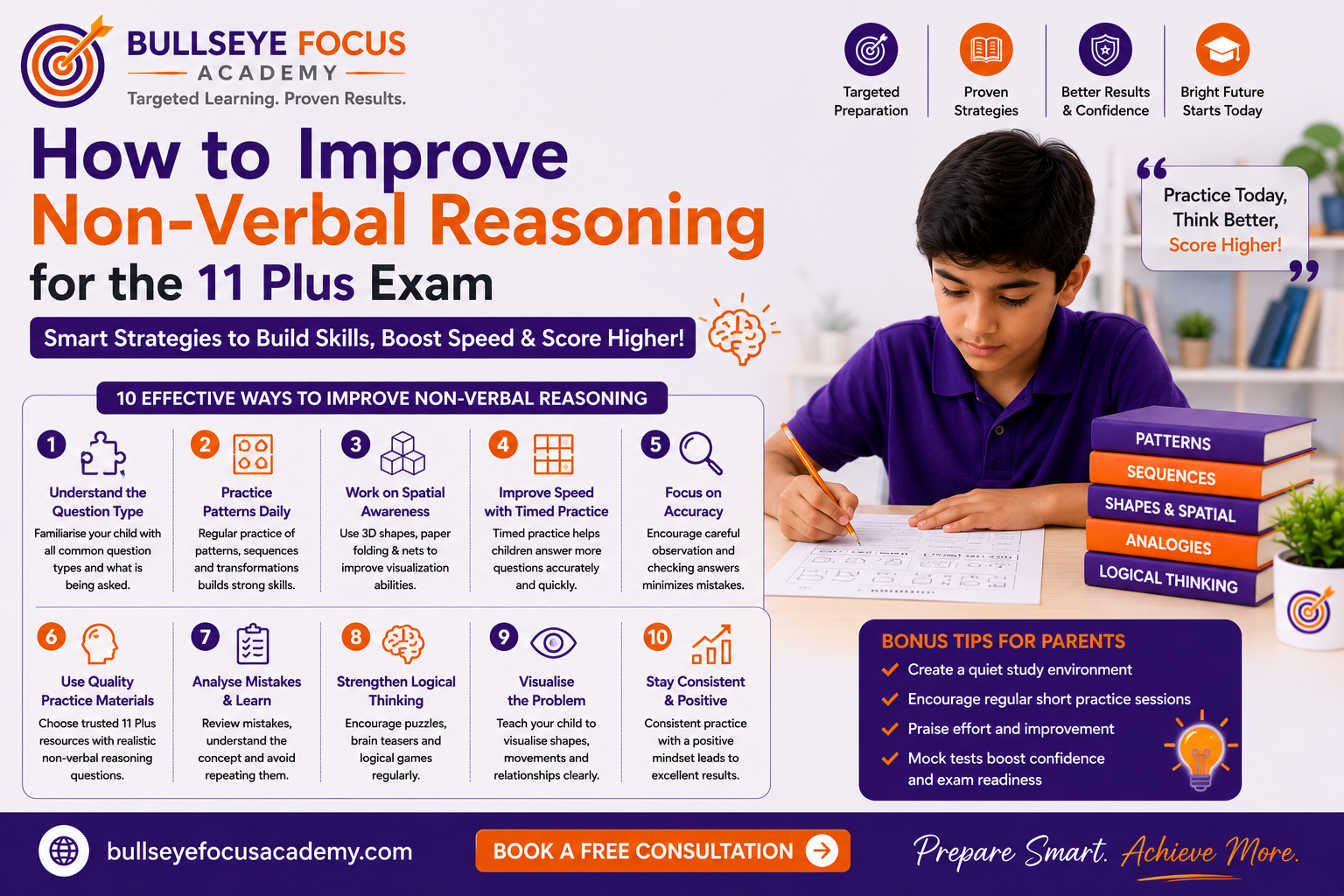
Strategy 1: Understand Common Question Types
The first step towards improving 11 Plus Non-Verbal Reasoning is becoming familiar with the different styles of questions. Students should learn how each question works before attempting to answer quickly. Understanding the structure reduces confusion and allows children to focus on solving the problem instead of interpreting the instructions. Parents can introduce one question type at a time before gradually increasing variety. This approach builds confidence while avoiding unnecessary frustration.
Strategy 2: Improve Visual Pattern Recognition
Pattern recognition forms the foundation of 11 Plus Non-Verbal Reasoning.
Students should practise identifying changes involving:
- Position
- Direction
- Rotation
- Colour
- Size
- Number of shapes
- Shading
Many questions follow predictable rules. The more patterns children encounter during practice, the faster they become at recognising similar relationships during the examination.
Strategy 3: Develop Observation Skills
Careful observation is essential for success. Students should learn to notice small differences between shapes rather than making quick assumptions.
Encourage children to compare:
- Corners
- Lines
- Angles
- Direction
- Missing parts
- Position
- Symmetry
Looking carefully before selecting an answer often prevents careless mistakes.
Strategy 4: Learn Shape Transformations
Many 11 Plus Non-Verbal Reasoning questions involve changes to shapes.
Students should practise recognising the following:
- Rotation
- Reflection
- Flipping
- Movement
- Enlargement
- Reduction
Once children understand these transformations, they can solve many question types much more quickly. Parents can use simple drawings at home to demonstrate how shapes change. Visual demonstrations often make difficult concepts easier to understand.
Strategy 5: Strengthen Logical Thinking
Although non-verbal reasoning focuses on pictures rather than words, logical thinking remains essential.
Students should ask themselves questions, such as:
- What has changed?
- What stays the same?
- Is there a repeated pattern?
- Which rule explains every shape?
- Which answer follows the sequence?
Developing this habit encourages systematic thinking instead of guessing.
Strategy 6: Practise Under Timed Conditions
Time management is one of the biggest challenges during 11 Plus Non-Verbal Reasoning examinations. Students often answer correctly during untimed practice but struggle when working against the clock.
Timed practice helps children:
- Increase speed
- Improve concentration
- Build confidence
- Reduce hesitation
- Develop better decision-making
Parents should gradually introduce realistic time limits rather than rushing children too early. Confidence develops best through gradual progression.
Why Reviewing Mistakes Is Essential
One of the biggest mistakes students make is completing practice papers without reviewing incorrect answers. Every mistake provides valuable learning opportunities.
After completing 11 Plus Non-Verbal Reasoning exercises, students should identify:
- Why the answer was incorrect.
- Which pattern was missed?
- Whether they rushed.
- Whether they misunderstood the question.
- How they will solve similar questions next time.
Keeping an error notebook allows students to monitor recurring mistakes and measure improvement over time.
Creating a Weekly Non-Verbal Reasoning Routine
A structured study routine helps students improve steadily without becoming overwhelmed.
A simple weekly plan might include:
Monday
- Shape recognition
- Pattern exercises
Tuesday
- Rotation questions
- Reflection activities
Wednesday
- Hidden shape practice
- Visual comparison exercises
Thursday
- Timed reasoning questions
- Review mistakes
Friday
- Mixed question practice
- Difficult question review
Weekend
- Full 11 Plus Non-Verbal Reasoning practice paper
- Detailed analysis of incorrect answers
Following a balanced routine encourages gradual improvement while maintaining motivation.
Official Information About Entrance Assessments
Parents who would like to learn more about educational assessments can visit the official GL Assessment website: https://www.gl-assessment.co.uk/
Official guidance helps families understand entrance examination standards and assessment expectations.
Strategy 7: Complete Regular Mock Exams
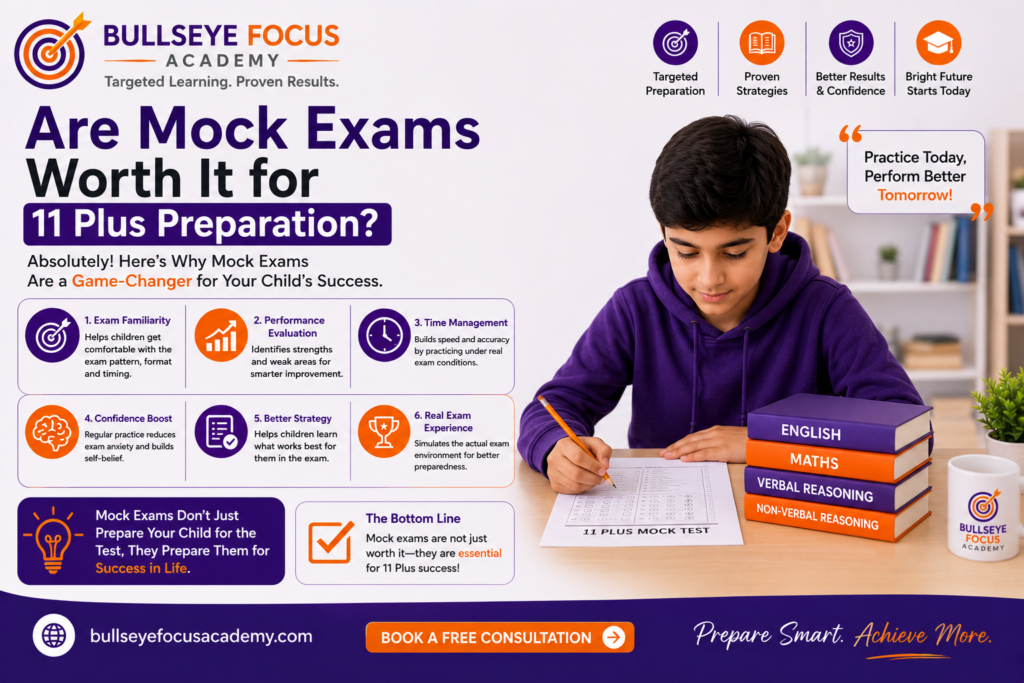
One of the most effective ways to improve 11 Plus Non-Verbal Reasoning is by completing regular mock examinations. Mock exams recreate real test conditions, helping students become familiar with time limits, question formats, and the pressure of working independently.
Regular 11 Plus Non-Verbal Reasoning mock exams help students:
- Improve time management.
- Build confidence.
- Increase accuracy.
- Develop exam techniques.
- Reduce exam anxiety.
- Become comfortable with realistic examination conditions.
Parents should encourage children to review every mock paper carefully. Understanding mistakes is much more valuable than simply checking the final score.
Strategy 8: Practise Little and Often
Many parents believe long study sessions produce the best results. However, 11 Plus Non-Verbal Reasoning improves more effectively through regular short practice sessions. A daily practice routine of twenty to thirty minutes often produces better progress than studying for several hours only once each week.
Consistent practice helps children:
- Recognise patterns more quickly.
- Improve observation skills.
- Increase confidence.
- Develop stronger logical thinking.
- Build long-term memory.
Small improvements made consistently lead to significant progress before the examination.
Strategy 9: Improve Concentration
Non-verbal reasoning requires careful attention to detail. Missing one small change in a shape or pattern can result in an incorrect answer.
Students can improve concentration by:
- Studying in a quiet environment.
- Taking short breaks during revision.
- Completing one question at a time.
- Avoiding unnecessary distractions.
- Sleeping well before study sessions.
Good concentration improves both speed and accuracy during 11 Plus Non-Verbal Reasoning practice.
Strategy 10: Build Confidence Through Gradual Progress
Confidence is an important part of examination success. Some students become discouraged when they answer difficult questions incorrectly. Parents should remind children that improving 11 Plus Non-Verbal Reasoning is a gradual process. Every practice session develops stronger reasoning skills.
Celebrate progress such as:
- Faster completion times.
- Higher scores.
- Fewer repeated mistakes.
- Better understanding of question types.
- Increased confidence.
Positive encouragement helps children remain motivated throughout preparation.
Strategy 11: Follow a Structured Study Plan
Students often achieve the best results when they follow a consistent study routine.
A balanced weekly plan should include:
- Pattern recognition.
- Shape transformations.
- Timed exercises.
- Mock examinations.
- Vocabulary and reading.
- Mathematics revision.
- Mistake analysis.
Following a structured routine prevents last-minute cramming and supports long-term learning.
How Parents Can Support Their Child
Parents have a major influence on a child’s preparation for 11 Plus Non-Verbal Reasoning.
Helpful ways to provide support include:
- Creating a quiet study space.
- Encouraging regular practice.
- Maintaining a consistent timetable.
- Praising effort rather than perfection.
- Helping children review mistakes.
- Keeping preparation positive.
Children who feel supported usually become more confident and resilient. Parents should avoid placing excessive pressure on scores and instead focus on continuous improvement.
Common Mistakes Students Should Avoid
Some preparation habits reduce the effectiveness of 11 Plus Non-Verbal Reasoning practice.
Guessing Without Looking Carefully
Students sometimes choose an answer too quickly. They should always compare every shape carefully before making a decision.
Ignoring Difficult Question Types
Avoiding challenging questions slows progress. Students should spend additional time practising areas they find difficult.
Practising Without Reviewing Mistakes
Completing practice papers without understanding incorrect answers limits improvement.
Every mistake should become a learning opportunity.
Focusing Only on Speed
Accuracy is just as important as speed. Students should first develop correct reasoning before trying to answer more quickly.
Inconsistent Practice
Irregular revision often leads to slower improvement. Regular short practice sessions usually produce stronger results than occasional intensive study.
Signs That Non-Verbal Reasoning Skills Are Improving
Parents often ask how they can recognise progress.
Positive signs include the following:
- Improved accuracy.
- Faster pattern recognition.
- Better time management.
- Increased confidence.
- Greater concentration.
- Reduced guessing.
- More consistent mock exam scores.
These improvements usually develop gradually through consistent preparation.
A Balanced Weekly Study Plan
A balanced preparation schedule helps students strengthen all the skills needed for the 11 Plus examination.
Monday
- Shape sequences.
- Pattern recognition.
Tuesday
- Rotation and reflection practice.
Wednesday
- Hidden shape exercises.
- Cube questions.
Thursday
- Timed 11 Plus Non-Verbal Reasoning practice.
Friday
- Review mistakes.
- Practise weaker question types.
Saturday
- Mixed reasoning activities.
- Logical thinking exercises.
Sunday
- Full 11 Plus Non-Verbal Reasoning mock paper.
- Detailed review and revision.
This balanced routine develops both confidence and consistency.
Why Personalised Learning Is Important
Every child learns differently. Some students quickly understand visual patterns but require additional help managing time. Others solve questions accurately but need more practice recognising shape transformations. Personalised preparation allows students to focus on their individual strengths and weaknesses rather than following a one-size-fits-all approach.
Families looking for structured learning support can explore:
https://bullseyefocusacademy.com/
Practice papers and preparation programmes are available at:
https://bullseyefocusacademy.com/shop/
Parents seeking personalised educational guidance can visit:
https://bullseyefocusacademy.com/contact-us/
Long-Term Benefits of Non-Verbal Reasoning Skills
Strong 11 Plus Non-Verbal Reasoning skills continue benefiting students throughout their education.
These skills support:
- Critical thinking.
- Logical reasoning.
- Mathematics.
- Science.
- Engineering.
- Technology.
- Problem-solving.
- Independent learning.
Developing visual reasoning skills helps children approach unfamiliar challenges with greater confidence.
FAQs
What is 11 Plus Non-Verbal Reasoning?
11 Plus Non-Verbal Reasoning measures a student’s ability to recognise visual patterns, analyse shapes, identify relationships, and solve logical problems using diagrams rather than written language. It assesses reasoning ability, observation skills, and problem-solving rather than memorised knowledge.
How can my child improve 11 Plus Non-Verbal Reasoning?
Children can improve 11 Plus Non-Verbal Reasoning through regular practice, learning common question types, completing timed exercises, reviewing mistakes, improving observation skills, and taking mock examinations under realistic conditions.
How often should students practise Non-Verbal Reasoning?
Most students benefit from practising 11 Plus Non-Verbal Reasoning for twenty to thirty minutes several times each week. Short, consistent study sessions generally produce better long-term improvement than occasional lengthy revision.
Do mock exams help improve Non-Verbal Reasoning?
Yes. 11 Plus Non-Verbal Reasoning mock exams help students improve confidence, time management, concentration, and exam technique while becoming familiar with realistic examination conditions before the actual test.
Why do students find Non-Verbal Reasoning difficult?
Many students initially struggle with 11 Plus Non-VerVerbal Reasoning because the question formats are unfamiliar. With regular practice, structured preparation, and careful review of mistakes, most children develop stronger reasoning skills and become much more confident.
Conclusion
Preparing for 11 Plus Non-Verbal Reasoning is about developing logical thinking, observation skills, and confidence through consistent practice rather than memorising answers. Although many children initially find visual reasoning questions unfamiliar, steady preparation helps them recognise patterns more quickly, analyse diagrams accurately, and solve problems efficiently under timed conditions.
Parents play an important role by providing encouragement, creating a positive learning environment, and supporting regular practice without adding unnecessary pressure. Reviewing mistakes, following a structured study plan, and completing realistic mock examinations all contribute to steady improvement and increased confidence.
Most importantly, success in 11 Plus Non-Verbal Reasoning develops gradually. Every practice session strengthens visual reasoning skills, improves problem-solving ability, and prepares students for the challenges of grammar school entrance examinations. With patience, consistent effort, and the right support, children can approach the 11 Plus exam with confidence and build valuable thinking skills that continue benefiting them throughout their education.