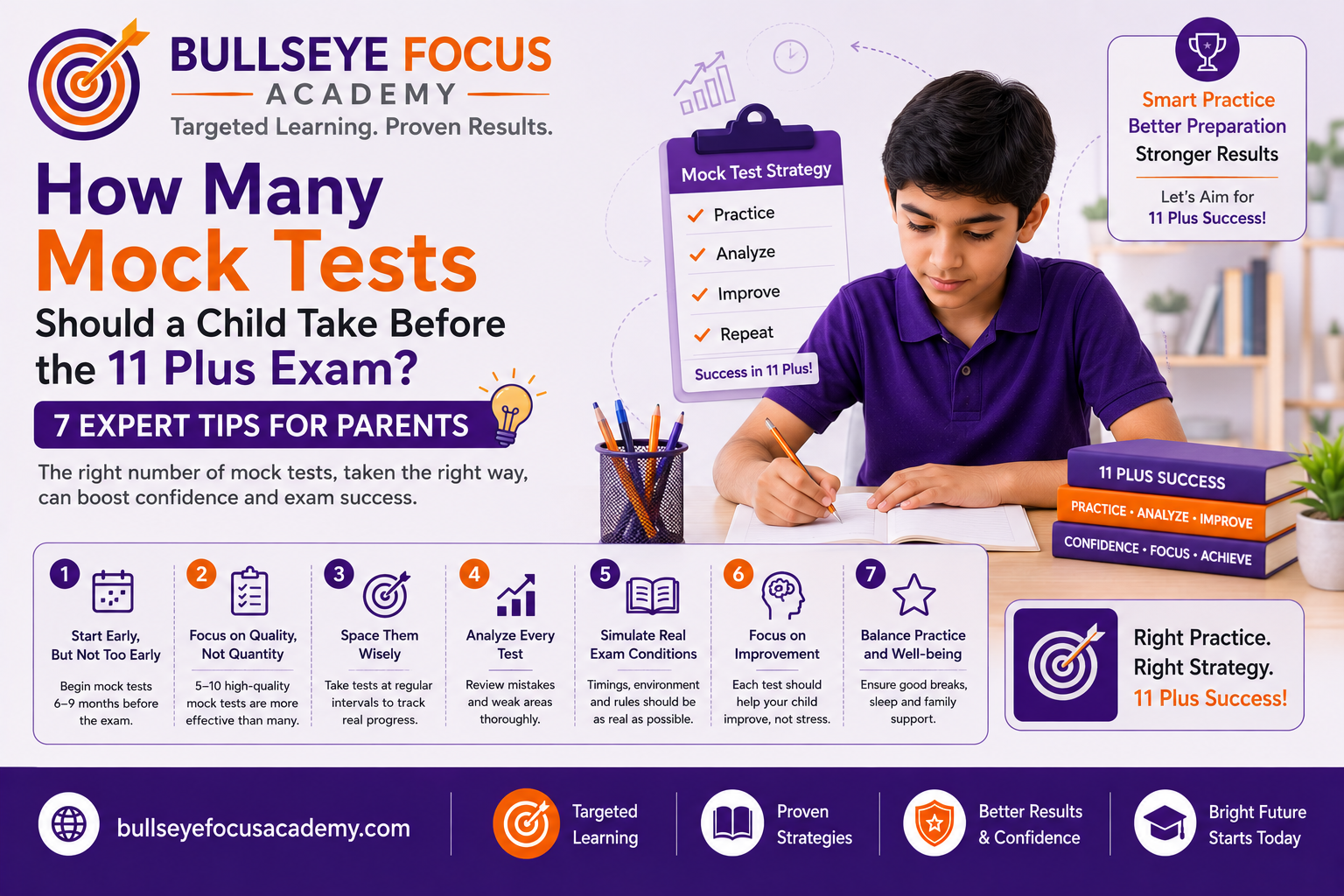
How Many Mock Tests Should a Child Take Before the 11 Plus Exam?
11 Plus Mock Tests are one of the most effective tools for preparing children for grammar school entrance exams. One of the biggest questions parents ask is, “How many mock tests should my child take before the 11 Plus exam?” The answer depends on the child’s confidence, preparation level, and individual learning needs rather than a fixed number. Many parents worry that taking too few mock tests will leave their child unprepared, while taking too many may cause stress or burnout. The right balance helps students become familiar with exam conditions, improve time management, identify weaker subjects, and build confidence without creating unnecessary pressure.
Unlike ordinary classroom assessments, the 11 Plus examination tests academic ability, reasoning skills, speed, and accuracy under timed conditions. Even highly capable students may struggle if they have never experienced a realistic exam environment. This is why 11 Plus Mock Tests play such an important role in successful preparation. Rather than focusing only on scores, parents should use mock tests to monitor progress, improve exam techniques, and help children become comfortable working under pressure. Every mock exam provides valuable feedback that can guide future revision and strengthen weaker areas before the real examination.
Parents looking for structured preparation programs and learning support can explore the following: https://bullseyefocusacademy.com/
Practice materials and preparation resources are available at: https://bullseyefocusacademy.com/shop/
Why Mock Tests Are Important for 11 Plus Preparation
Many children have strong academic knowledge but still struggle during competitive entrance exams because they are unfamiliar with timed assessments. 11 Plus Mock Tests bridge this gap by allowing students to experience realistic examination conditions before the actual test.
Regular mock exams help students understand:
- How the examination is organised
- The types of questions they may face
- How much time should be spent on each section
- How to remain calm under pressure
- How to avoid common mistakes
As students complete more practice exams, they become increasingly confident and comfortable with the testing process. The actual examination often feels less intimidating because they have already experienced similar conditions multiple times. Parents should remember that mock exams are learning tools rather than performance rankings. Every paper completed provides an opportunity for improvement.
What Do 11 Plus Mock Tests Measure?
Many parents believe mock exams simply test subject knowledge. In reality, they assess several important academic and personal skills that influence overall performance.
These include:
- English comprehension
- Mathematics
- Verbal reasoning
- Non-verbal reasoning
- Time management
- Problem-solving ability
- Accuracy
- Concentration
- Decision-making under pressure
Strong performance comes from developing all of these skills together rather than focusing on memorising answers. Parents who want to understand the structure of grammar school entrance assessments can visit the official GL Assessment website for information about assessment formats and educational resources: https://www.gl-assessment.co.uk/
Is There an Ideal Number of Mock Tests?
There is no universal number that guarantees success. However, educational specialists generally recommend completing between 8 and 15 well-planned 11 Plus Mock Tests before the real examination.
The exact number depends upon the following:
- Academic ability
- Confidence levels
- Previous exam experience
- Individual progress
- Time available before the examination
Some students may need only a small number of carefully reviewed mock exams, while others benefit from additional practice. Quality is always more valuable than quantity. A child who completes ten mock tests and carefully analyses every mistake will usually improve more than a student who rushes through twenty papers without reviewing errors.
When Should Students Begin Mock Tests?
Mock exams should be introduced after students have developed solid foundations in English, mathematics, verbal reasoning, and non-verbal reasoning. Most children begin structured 11 Plus Mock Tests during Year 5 after completing several months of subject preparation.
A gradual approach often works best.
Early Preparation Stage
Children should focus on the following:
- Reading regularly
- Vocabulary development
- Mental mathematics
- Basic reasoning exercises
- Problem-solving skills
At this stage, full mock exams are generally unnecessary.
Intermediate Stage
Once students become comfortable with the main subjects, parents can introduce the following:
- Timed topic tests
- Short practice papers
- Mini assessments
- Section-based mock exams
These shorter assessments help students adjust to working under time limits.
Final Preparation Stage
Several months before the examination, students can begin taking full-length 11 Plus Mock Tests under realistic conditions.
This stage focuses on:
- Exam confidence
- Speed
- Accuracy
- Time management
- Stamina
Benefits of Taking Regular Mock Tests
Students who complete regular 11 Plus Mock Tests often experience significant improvements across several areas.
Improved Time Management
Many students lose marks because they spend too long answering difficult questions.
Timed mock exams teach children the following:
- Work efficiently
- Allocate time wisely
- Move on when necessary
- Finish papers within the time limit
These skills become increasingly important as the examination approaches.
Increased Confidence
Confidence grows through familiarity. Students who regularly complete mock exams become less anxious because they know what to expect on exam day.
Confidence helps children:
- Remain calm
- Think clearly
- Make better decisions
- Reduce careless mistakes
Better Understanding of Weak Areas
Every mock exam highlights strengths and weaknesses.
Parents can use results to identify:
- Topics requiring revision
- Common mistakes
- Timing difficulties
- Knowledge gaps
This information allows future study sessions to become more focused and productive.
Improved Exam Technique
Strong subject knowledge alone does not guarantee success.
Students also need effective exam techniques such as:
- Reading instructions carefully
- Answering easier questions first
- Checking answers when time allows
- Avoiding unnecessary risks
These techniques improve naturally through repeated practice.
How Often Should Mock Tests Be Taken?
The frequency of mock exams should increase gradually.
An example preparation schedule may include:
Six to Eight Months Before the Exam
One short assessment every two or three weeks.
Four to Six Months Before the Exam
One subject-specific mock exam every two weeks.
Two to Three Months Before the Exam
One full mock exam every week.
Final Month
One full mock exam every seven to ten days with detailed performance reviews. Parents should avoid scheduling mock exams too frequently because students also need time for revision and improvement.
Why Reviewing Mistakes Is More Important Than Taking More Tests
One of the biggest misconceptions about 11 Plus Mock Tests is that simply completing more papers automatically leads to higher scores. In reality, improvement comes from analyzing mistakes.
After every mock exam, students should:
- Review incorrect answers
- Understand why mistakes occurred
- Learn correct methods
- Practise similar questions
- Record recurring errors
Keeping an error notebook is an excellent way to monitor progress. Students often notice recurring patterns that can be corrected before the real examination.
Building Exam Stamina
The 11 Plus examination requires sustained concentration over an extended period. Children who rarely sit long assessments may become mentally tired before completing the paper. Regular 11 Plus Mock Tests gradually build exam stamina by helping students maintain concentration for longer periods.
Benefits include:
- Better focus
- Reduced fatigue
- Improved concentration
- Fewer careless mistakes
- Greater confidence during lengthy assessments
As stamina improves, students often find that the actual examination feels less demanding.
Using Mock Tests Without Creating Pressure
Parents should remember that preparation should remain positive.
Mock exams should never become a source of fear.
Helpful approaches include:
- Praising effort rather than scores
- Discussing mistakes constructively
- Setting realistic goals
- Encouraging gradual improvement
- Maintaining healthy routines
Children who feel supported usually perform better than those who feel excessive pressure. Positive encouragement builds resilience and confidence throughout the preparation process.
For additional guidance, parents can explore personalised learning support through: https://bullseyefocusacademy.com/contact-us/
Structured preparation combined with well-planned 11 Plus Mock Tests helps children develop confidence, improve academic performance, and approach grammar school entrance exams with greater self-belief.
Common Mistakes Parents Should Avoid When Using Mock Tests
While 11 Plus Mock Tests are an excellent preparation tool, some common mistakes can reduce their effectiveness. Parents who understand these pitfalls can help their children make the most of every practice session.
Taking Too Many Mock Tests
Some parents believe that completing as many mock papers as possible will automatically improve results. However, excessive testing can lead to mental fatigue and reduced motivation. Instead of focusing on quantity, children should complete a manageable number of mock tests and spend time reviewing each one carefully. A balanced approach helps students learn from their mistakes while maintaining confidence and enthusiasm.
Ignoring Mistakes
Completing a mock paper without reviewing incorrect answers is a missed learning opportunity.
After every test, students should identify:
- Incorrect answers
- Questions they guessed
- Topics they found difficult
- Time management issues
- Careless mistakes
Understanding why mistakes happened helps children avoid repeating them during the real examination.
Comparing Results With Other Children
Every child learns at a different pace. Comparing scores with classmates or friends can increase anxiety and reduce confidence.
Parents should focus on:
- Personal improvement
- Individual progress
- Consistent effort
- Developing exam skills
Success is measured by steady improvement rather than competition with others.
Creating Too Much Pressure
The purpose of 11 Plus Mock Tests is to prepare children, not to make them feel overwhelmed.
Parents should avoid:
- Constant criticism
- Unrealistic expectations
- Excessive study hours
- Negative comparisons
Positive encouragement usually produces better long-term results.
Skipping Revision Between Mock Tests
Mock exams should be separated by periods of revision.
After each test, children should revise weak topics before attempting another paper. This approach ensures continuous improvement rather than repeating the same mistakes.
How Parents Can Use Mock Test Results Effectively
Every mock exam provides valuable information that can guide future preparation.
Parents can use results to:
- Identify weak subjects
- Recognise improvement
- Adjust study schedules
- Set realistic goals
- Monitor confidence levels
Instead of focusing only on marks, parents should discuss what their child learned from each assessment.
Simple questions such as:
- Which section felt easiest?
- Which questions were difficult?
- Did you manage your time well?
- What will you improve next time?
Encourage children to reflect on their performance and become more independent learners.
Creating a Balanced Mock Test Schedule
A structured schedule helps children remain motivated while avoiding burnout.
An effective weekly routine may include:
Monday
- English revision
- Vocabulary practice
Tuesday
- Mathematics problem-solving
- Mental arithmetic
Wednesday
- Verbal reasoning exercises
Thursday
- Non-verbal reasoning practice
Friday
- Review previous mistakes
Weekend
- One 11 Plus Mock Tests session followed by detailed analysis
This balanced approach combines learning, revision, and assessment without overwhelming the student.
How Mock Tests Build Confidence
Confidence is one of the greatest benefits of regular 11 Plus Mock Tests.
Children who complete realistic practice papers become familiar with the following:
- Exam instructions
- Time limits
- Question formats
- Answer sheets
- Working under pressure
As these situations become familiar, anxiety decreases naturally. Students also develop confidence because they can see measurable improvement over time. Even small improvements in scores, timing, or accuracy motivate children to continue working hard.
The Psychological Benefits of Mock Tests
Mock exams provide benefits that extend beyond academic performance.
Reduced Exam Anxiety
Children often fear unfamiliar situations. Regular 11 Plus Mock Tests make exam conditions feel normal rather than intimidating.
Improved Self-Belief
As students complete more practice papers successfully, they begin trusting their own abilities. Confidence often becomes one of the biggest factors contributing to improved performance.
Better Emotional Control
Students learn to remain calm after making mistakes and continue answering remaining questions effectively. This emotional resilience becomes valuable during many future examinations.
Stronger Concentration
Completing full-length papers improves attention span and mental endurance. Students gradually become capable of maintaining concentration throughout the examination.
Balancing School Learning With Mock Tests
Parents sometimes worry that mock exams may interfere with school learning.
In reality, well-planned 11 Plus Mock Tests often strengthen classroom performance because students develop:
- Better study habits
- Improved organisation
- Stronger problem-solving skills
- Greater confidence
- Enhanced concentration
Preparation should always complement school learning rather than replace it. Children should continue participating in school activities, hobbies, exercise, and family time while preparing for the examination.
When Should Parents Reduce Mock Tests?
As the examination approaches, some parents increase the number of practice papers dramatically. However, during the final week before the exam, it is often better to reduce testing.
Instead, students should focus on:
- Reviewing previous mistakes
- Revising key concepts
- Reading regularly
- Sleeping well
- Maintaining confidence
The final days should help children feel calm and prepared rather than exhausted.
Signs That Mock Test Preparation Is Working
Parents often wonder whether preparation is progressing successfully.
Positive signs include the following:
- Improved confidence
- Faster completion times
- Better accuracy
- Reduced anxiety
- Stronger concentration
- More consistent scores
- Greater independence
These improvements indicate that the child’s preparation is moving in the right direction.
Why Every Child Needs a Different Number of Mock Tests
One of the biggest misconceptions about 11 Plus Mock Tests is that every child should complete exactly the same number. In reality, preparation should be personalized. Some students become confident after completing eight well-reviewed mock papers. Others benefit from twelve or fifteen practice exams because they need additional experience working under timed conditions.
Parents should base decisions on:
- Confidence
- Progress
- Understanding
- Emotional well-being
- Readiness
Quality preparation is always more valuable than simply increasing the number of tests.
Supporting Your Child Throughout the Journey
Preparing for the 11 Plus examination is not only an academic challenge but also an emotional journey.
Parents can provide valuable support by:
- Encouraging consistent effort
- Celebrating improvement
- Listening to concerns
- Maintaining positive communication
- Avoiding unnecessary pressure
- Supporting healthy routines
Children who feel supported usually approach the examination with greater confidence and resilience.
For additional preparation guidance, parents can visit the following: https://bullseyefocusacademy.com/
Practice materials and learning programs are available at: https://bullseyefocusacademy.com/shop/
For personalized educational support, visit: https://bullseyefocusacademy.com/contact-us/
FAQs
How many 11 Plus Mock Tests should my child take?
Most education specialists recommend completing between 8 and 15 11 Plus Mock Tests before the actual examination. The ideal number depends on your child’s confidence, academic ability, progress, and familiarity with exam conditions. Quality is more important than quantity, so every mock test should be followed by careful review and targeted revision.
When should students start taking 11 Plus mock tests?
Students usually begin 11 Plus Mock Tests during Year 5 after developing a solid understanding of English, mathematics, verbal reasoning, and non-verbal reasoning. Starting too early may create unnecessary pressure, while starting too late reduces opportunities to improve exam technique and confidence.
Do mock tests improve exam performance?
Yes. Regular 11 Plus Mock Tests improve time management, accuracy, confidence, concentration, and familiarity with exam conditions. Students also learn how to manage pressure, avoid common mistakes, and develop effective exam strategies, which often leads to stronger overall performance.
Should parents review every mock test?
Absolutely. Reviewing every 11 Plus Mock Tests paper is one of the most valuable parts of preparation. Analyzing mistakes helps students identify weak topics, understand incorrect answers, and improve future performance instead of repeating the same errors.
Can too many mock tests be harmful?
Yes. Taking excessive 11 Plus Mock Tests without enough revision can cause stress, fatigue, and reduced motivation. A balanced preparation plan that combines mock exams with revision, rest, and confidence-building activities is generally much more effective.
Conclusion
11 Plus Mock Tests are one of the most valuable resources available for preparing children for grammar school entrance examinations. They help students become familiar with real exam conditions, strengthen time management skills, improve accuracy, and build the confidence needed to perform well under pressure. However, success does not depend on completing the highest number of mock papers. The most effective approach is to use each mock test as a learning opportunity. Careful review, consistent revision, and gradual improvement are far more beneficial than rushing through large numbers of practice exams. Most students achieve excellent progress by completing between eight and fifteen well-planned mock tests alongside regular subject revision and constructive feedback.
Parents also play an essential role throughout this journey. By providing encouragement, maintaining realistic expectations, creating a positive study environment, and supporting healthy routines, families can help children approach the examination with confidence rather than anxiety. With thoughtful preparation, personalized learning, and regular 11 Plus Mock Tests, students can develop the academic skills, resilience, and self-belief needed not only for the 11 Plus examination but also for long-term educational success.